
1Rulebook Overview#
Congratulations to all teams for your hard work this season, and we hope you had a fantastic experience at your local Regional Competition! To all teams who have earned a spot at the National Championship, we are excited to provide this opportunity to compete against teams from all regions.
This rulebook will discuss the updated game rules which will be used at the 2024 National Championship. We highly recommend you read through the entire rulebook at least once, getting familiar with the requirements and noting any questions you may have. We also recommend printing a copy for your team to have on hand during meetings.
Please note that this document will cover the updated rules only – unless otherwise stated, all other rules from the Regional Competition Rulebook will still be in effect.
See stemed.org/arc to find the Regional Competition Rulebook, along with any other announcements and documents produced.
If you have any questions about the rulebook, you are always welcome to contact Support@stemed.org for assistance. We look forward to a great event!
2Logistics#
National Invitational Event
The Aerospace Robotics Competition currently consists of four (4) regions:
- Antelope Valley, CA: AntelopeValley@stemed.org
- New England: NewEngland@stemed.org
- Philadelphia, PA: Philadelphia@stemed.org
- San Diego, CA: SanDiego@stemed.org
- Other: Support@stemed.org
Each region consists of up to twenty (20) teams, with volunteers providing local support and events. Each region also hosts a Regional Aerospace Robotics Competition event annually in April or May.
Champions from each region are invited to participate in the 2024 National Championship. As is required for the Regional Competitions, all team members must submit a waiver signed by a parent or guardian in order to participate. Please visit the ARC website for waivers and other submissions (stemed.org/arc-submissions).
There are no fees required to attend the National Championship.
Further details will be sent to invited teams. Please contact Support@stemed.org with any questions.
3Mission Background#
You may be wondering: Why autonomy? Why UAVs?
Consider the world we live in today. On one hand, there are constant, cutting-edge advancements in technology. NASA recently landed Perseverance on Mars and successfully executed a powered flight of a drone on another planet. Many countries harbor sophisticated biotech abilities, helping us generate vaccines to combat new and emerging viruses with astounding agility. On the other hand, our world is facing constant crises as well. As the Earth continues to spin, we have seen more disasters, both natural (tornados, earthquakes, tsunamis, wildfires) and human-made (nuclear plant meltdowns, waste buildups, hazardous material spills). How do we reconcile these opposing forces? How can UAV/drone usage make a positive and lasting impact on society?
There are many examples of how drones can be used in disaster management to reduce cost and safety risk, including:
1. 2. 3. 4. 5. 6.
Count the number of people at specific waypoints. Create an optimized path between waypoints to guide people to safety Deliver supplies and food to specific waypoints. Assess buildings for structural damage Assess power grid integrity Provide internet access to stranded people
Our mission for the autonomous portion of the competition incorporates such disaster management.
The year is 2024, and your local government has tasked your team with responding to a natural disaster. You are required to perform the following tasks:
- Scouting: Measure GPS coordinates of safe air zones and of fire, then enter coordinates into flight plan.
- Loiter Waypoint: Hover in a safe air zone at the specified GPS waypoint.
- Delivery Waypoint: Release water over the fire at the specified GPS waypoint.
- Environmental Cleanup: Sort the trash and recycling into their appropriate bins.
In a real-world application, drones may loiter to transmit or receive information or await further commands. While the competition scope does not include any activity at the loiter waypoint besides hovering, these waypoints are equally important for the drone’s overall mission success.
4Mission Details#
The following subsections give the mission details and scoring equations for the Autonomous, Semi-Autonomous, and Technical Presentation components of the competition.
The below table presents the available points for this year’s challenges. Each team may choose to participate in some or all components of the competition, with the following point values available for each task. Technical Presentation Content points will be earned up to one week before the competition date, while all other points are earned in-person at the competition. The total sum of points by the end of the competition will be used to determine awards (see Section 6). Note that some scoring equations and totals have changed significantly for the National Championship.
| Event | Task | Max Points | Max Total |
|---|---|---|---|
| Autonomous Flight | Fly-Off | 350 | 350 |
| Semi-Autonomous Flight | Head-to-Head | 350 | 350 |
| Technical Presentation | Content | 200 | 300 |
| Style | 100 | ||
| Maximum | Total Score | 1,000 |
Major Rule Updates
Read the respective rulebook sections for details.
- Autonomous Fly-Off: o Additional waypoint (refuel station)
- Semi-Autonomous Head-to-Head: o Increased quantity of tennis and wiffle balls o Moving landing pad o Speed bonuses
- Technical Presentation: o Increased requirements
Rule Clarifications
- Teams must leave the landing pad during the Semi-Autonomous Head-to-Head round to receive points
for ending the round on the landing pad.
Autonomous Competition
Overview
- One portion:
- Fly-Off Competition: Live autonomous mission
- Eligibility:
- Teams must submit Virtual Tasks 0 and 5 to compete in the fly-off portion.
- If your team did not complete this task before your Regional Competition, you may submit it at least 7 days before the National Championship to complete this requirement.
- Inspection: Teams must pass technical inspection to compete in the fly-off portion
- See General UAV Requirements
Virtual Competition
- Tasks: See Table 2 below
- Task 0 must be completed to be eligible to compete in ANY fly-off portion of the competition
- Submission:
- Teams must record the drone or any needed equipment (ex. computer screen) in order to demonstrate that the task has been accomplished.
- Supporting files should be submitted here: stemed.org/arc-submissions
- Virtual Competition Judges will accept or reject submissions based on a scoring rubric that is based on the description. Teams will receive a decision on their submission within 2-4 days.
- Each submission will receive one of two outcomes: accept or reject. If a team receives a “reject”, the judges have deemed that the team has not accomplished the task OR the submission has insufficient proof that the team has accomplished the task. Teams may resubmit before the deadline.
- Teams are allowed to attempt each task as many times as needed before competition day, regardless of the number of rejections received.
- All submissions must be received at least 7 days before the competition. All submissions will be evaluated by competition day.
| Task # | Task Name | Description |
|---|---|---|
| 0 | Pass TRUST Exam |
|
| 5 | Mechanism Test |
|
Autonomous Fly-Off Competition
- Purpose: Students combine the skills learned from the virtual tasks to fly an autonomous firefighting challenge.
- Tasks:
- Scouting: Teams must identify GPS coordinates and enter them into their drone.
- There will be three (3) waypoints for students to find:
- One (1) green waypoint will represent a waypoint for the drone to hover and surveil the area.
- One (1) red waypoint will represent a fire which must be fought.
- One (1) landing pad will represent a refuel station.
- Each waypoint will be labeled with its respective GPS coordinates.
- Students must identify the waypoints and enter the correct GPS coordinates into their drone’s flight plan.
- The drone’s battery must be unplugged while students are on the flying field. Once students have gathered the GPS coordinates and have exited the field, they may then plug in the battery. They must remain outside of the field’s perimeter once the battery is connected.
- The drone must be tethered before the timer begins. This will ensure teams do not forget to tether their drone while rushing to complete the challenge.
- Surveillance Challenge: Teams must successfully fly over assigned GPS waypoint.
- There will be one (1) surveillance waypoint.
- Teams must loiter over this waypoint for five (5) seconds to allow Flight Judges to ensure the drone has passed over the correct coordinates.
- Refuel Challenge: Teams must land on the landing pad between completing the safe and fire waypoints to simulate the need to refuel between tasks.
- Firefighting Challenge: Teams must successfully drop an eight fluid ounce (8 fl. oz.) water balloon over assigned GPS waypoint.
- The water balloon will simulate a firefighting drone quenching a fire.
- The water balloon will be filled to approximately 3.0” wide and 4.5” long.
- Note that water balloons may not always meet these precise dimensions. Teams should design and practice using a range of balloon sizes to ensure their mechanism will be capable of handling the water balloon at the competition.
- Water Balloon: Zuru Bunch O Balloons
- Teams must create a mechanism and procedure to release the water balloon. Extra points are awarded if this release is completed autonomously.
- Only one water balloon will be dropped and scored.
- The quadcopter may not land to accomplish this task. Landing will automatically end the attempt.
- The drone must drop from a minimum height of 10 ft.
- The water balloon must be delivered to within 20 ft of the drop waypoint.
- The drone must drop the water balloon while loitering over the waypoint. Drones should not drop the water balloon while traveling.
- There will be one round per team for the autonomous portion.
- Procedure:
- Teams must tether their drone to the middle of the field before the timer begins.
- Teams will enter the field to read the GPS coordinates of waypoints.
- Students represent human firefighters on the ground. They will identify a surveillance waypoint, as well as a fire waypoint which is too dangerous for human intervention. They will use their UAV to autonomously quench the fire.
- Teams will use these GPS coordinates to calculate the route that their UAV will travel to complete the mission. Once the route is calculated, the UAV will autonomously complete the mission per the calculated route.
- After teams have recorded their GPS coordinates and exited the field, they may plug in the drone’s battery. Once the battery is connected, students may not enter the field again.
- Vehicles must take off autonomously and complete the following steps in order:
- Hover over the surveillance waypoint.
- Land on refuel waypoint.
- Takeoff.
- Hover over fire waypoint.
- Release water balloon over fire waypoint.
- Return to home landing pad.
- Teams who land at the fire waypoint will receive a score of zero, as this simulates the drone landing within a fire. It is recommended that teams return to their home waypoint for landing to receive the maximum score.
- Since GPS is not 100% accurate, teams may autonomously approach the landing pad then manually complete the landing if the drone is attempting to fly outside of the field boundary.
- See Figure 1 for an example mission field layout.
- Time Requirements:
- Teams will receive five (5) minutes to complete this mission.
- This five-minute limit includes time to read the GPS coordinates of both waypoints, calculate the flight route, and execute the flight.
- If the UAV is in the air after five minutes, teams may continue the round for one more minute with a fifty (50) point penalty.
- If the drone does not land within six (6) minutes, the team will receive a score of zero (0) for the round.
- Fifty (50) bonus points are awarded for teams who take off within three (3) minutes.
- The timer starts when teams are ready to enter the field and begin reading GPS coordinates. The timer runs continuously until 6 minutes have expired.
- The Flight Manager will signal the start of the stopwatch for each team to enter the field.
- The timing will stop when the vehicle has landed, signaling the flight is complete.
- If the team has not completed the mission by the 6-minute mark, the Flight Manager will order the team to return their UAV to the home waypoint if the vehicle is airborne.
- The time taken to land the vehicle will be included in the final flight time.
- If the team does not land their vehicle within 15 seconds of this direction from the Flight Manager, the team will receive an automatic score of 0 points for this flight round.
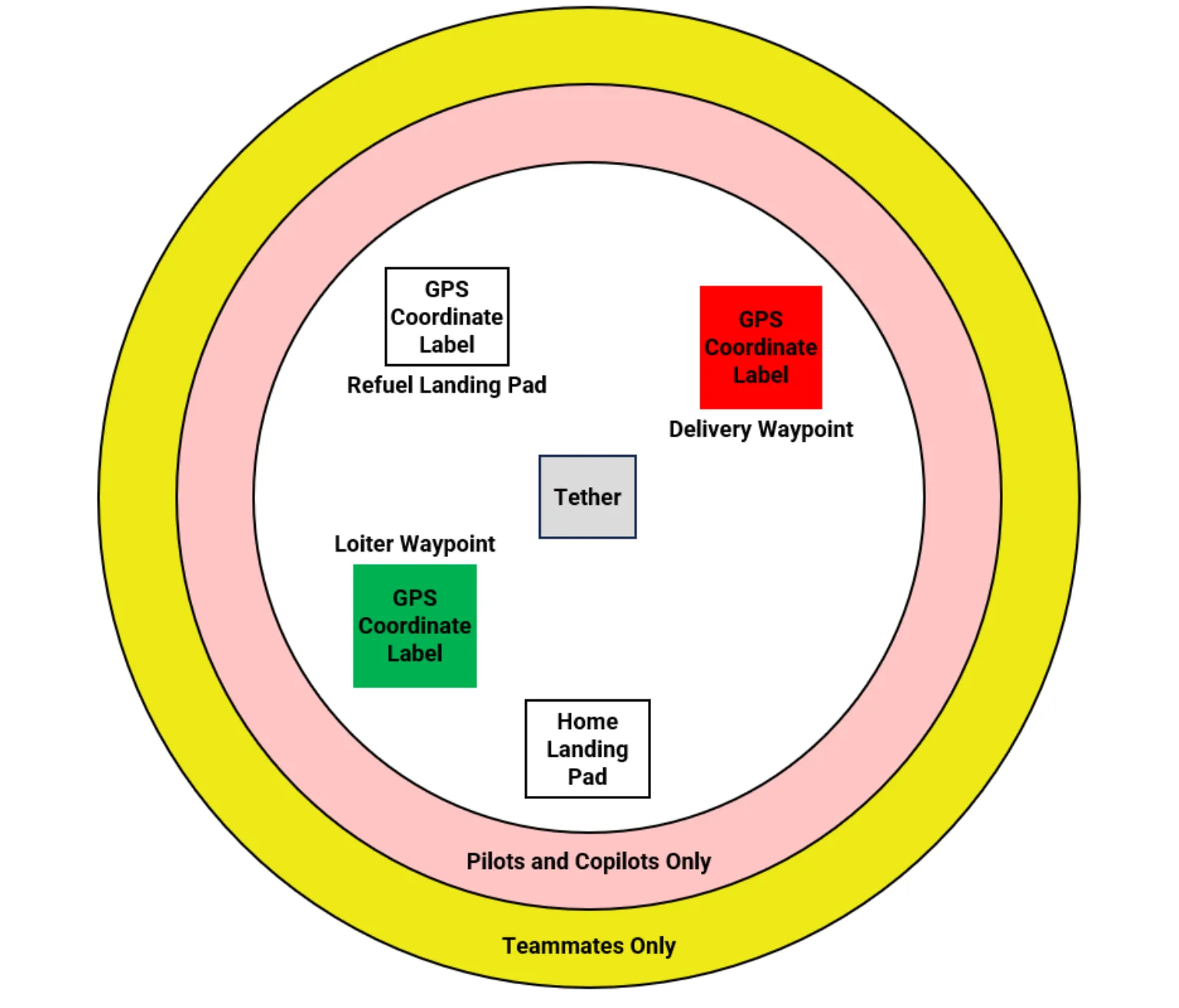
Autonomous Scoring Equations
The fly-off score is calculated by the following equation:
𝐸 + 𝑊 + 𝑅+𝐿 + 𝑆 − 𝑃 𝐴
𝐹𝑙𝑦 − 𝑂𝑓𝑓 𝑆𝑐𝑜𝑟𝑒 =
| Variable | Requirement | Value |
|---|---|---|
| E | Water balloon is released, lands within 20 ft. of target, and bursts | 100 |
| Water balloon is released and lands within 20 ft. of target, but does not burst | 75 | |
| Water balloon is released but does not land within 20 ft. of target | 25 | |
| Water balloon is not released | 0 | |
| W | Drone successfully flies over both waypoints | 100 |
| Drone successfully flies over one waypoint | 50 | |
| Drone does not successfully fly over either waypoint | 0 | |
| R | Drone successfully completes refuel mission** | 50 |
| L | Drone successfully finishes round on a landing pad** (Either the refuel waypoint or the takeoff landing pad) | 50 |
| A | Autonomous trigger used to drop water balloon | 1 |
| Manual trigger used to drop water balloon | 2 | |
| S | Team takes off within first 3 minutes of flight round | 50 |
| P | Team takes over 5 minutes, but under 6 minutes, to complete challenge | 50 |
| Team does not land within 6 minutes | DQ* | |
| No penalty | 0 | |
| Maximum Total Score | 350 |
*A DQ (disqualification) causes teams to lose all points earned during the match, resulting in a total score of zero points for the flight round.
**It is understood that landing precisely on the landing pad may be difficult due to weather conditions and/or electronics inaccuracy. Teams will be awarded points for landing close to the landing pad (at the discretion of the Field Manager).
Semi-Autonomous Competition
Overview
- Purpose: Two teams at a time, seeded according to their Time Trial ranking, completing environment cleanup mission.
- Eligibility:
- Inspection: Teams must pass technical inspection to compete in the Time Trials or Head-to-Head Competition.
- See General UAV Requirements
- Task 0: Teams MUST complete Task 0 to participate in any flight rounds.
Head-to-Head Competition
- Purpose: Students will learn to semi-autonomously pilot their drones, communicate between the pilot and copilot, and avoid their opponent while completing a challenge to clean their environment.
- Tasks:
- Teams must pick up tennis balls and wiffle balls and deliver them to hoops in the center of the flying field.
- Hoops will be of varying diameters with varying points associated with them.
- Large Hoop = 20-inch diameter
- Medium Hoop = 16-inch diameter
- Small Hoop = 12-inch diameter
- All hoops have approximate height of 2.75 feet
- Procedure:
- Teams must tether their drone to the middle of the field before plugging in batteries.
- There will be a maximum of 4 semi-autonomous rounds.
- Drones will be piloted by 1 student pilot.
- Teams may select 1 copilot to assist the student pilot.
- Pilots and copilots must wear safety glasses. Hard hats are recommended.
- Pilots will fly their vehicles to retrieve tennis balls and wiffle balls from queue areas on the ground then drop these balls through hoops to score points.
- Wiffle balls represent recyclable items and may only be delivered into the medium hoop.
- Tennis balls represent trash and may only be delivered in the large and small hoops.
- Once the ball is in the hoop, the score will be awarded.
- If the ball bounces out of the goal, it will still be considered as scored. Teams may not pick up this ball and score it again for extra points.
- There is no limit to how many balls teams may carry at once.
- Teams may only pick up balls from their staging area; they may not pick up their opponent’s tennis or wiffle balls.
- If the hoop is knocked over by either drone, the hoop will be ineligible to have balls dropped into for the rest of the round.
- During flight, intentional collisions/interference are prohibited. Teams causing a collision will be disqualified.
- Time Requirements:
- There will be a 5-minute time limit for each flight round.
- The Flight Manager will signal the start of the flight round by instructing teams to arm their drones. The 5-minute stopwatch starts at this time.
- Each team will pick up and deliver up to 6 tennis balls and 6 wiffle balls through the hoops.
- A ball pick-up is defined as the ball leaving the ground while attached to the drone and in the air for more than 2 seconds.
- Tennis Balls: Penn Championship Tennis Balls, Extra-Duty Felt
- Wiffle Balls: Franklin Sports Indestruct-A-Ball Plastic Training Balls
- Speed Challenges:
- Teams will receive points for being the first to score into each hoop during the current round (see scoring equations below).
- Teams will receive points for being the first to finish their flight by landing on the landing pad.
- Rules:
- Teams must score all of their playing pieces before using the moving landing pad.
- Teams MAY NOT land on a landing pad that is already occupied by their opponent. Please remember that teams causing a collision will be disqualified.
- Landing pad details: This landing pad will be a 3’x3’ wooden pad painted white. The landing pad will be on 4 wheels and pulled back and forth across the field at an even pace for all teams. Teams must land on this moving target to complete the challenge.
- Teams have 5 minutes to drop all tennis and wiffle balls. If a team finishes this task early, they should land their vehicle (See Figure 2).
- If a team’s drone flips or is damaged, team members may not enter the arena to retrieve their drone. The team must wait until the round’s time is complete or until the opposing team’s drone is also incapacitated. At this point, the round will be considered complete, and teams may retrieve their drones at the instruction of the Flight Manager.
- If either team is still airborne when 5 minutes have passed, the Flight Manager will instruct the pilot to land the vehicle.
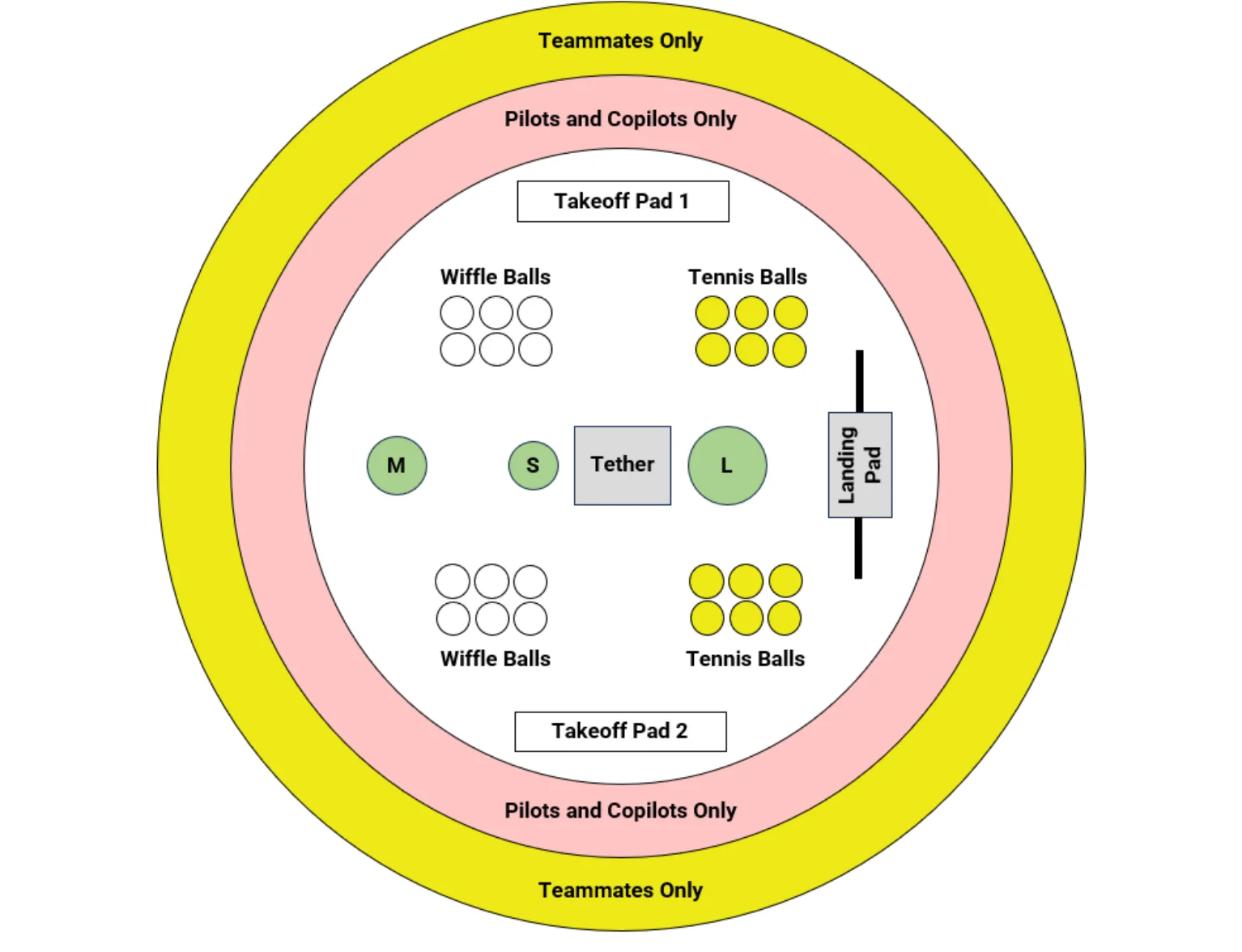
Semi-Autonomous Scoring Equations
The Head-to-Head Competition score is calculated by the following equation:
𝐻𝑒𝑎𝑑 − 𝑡𝑜 − 𝐻𝑒𝑎𝑑 𝐶𝑜𝑚𝑝𝑒𝑡𝑖𝑡𝑖𝑜𝑛 𝑆𝑐𝑜𝑟𝑒 = 𝑎𝑣𝑒𝑟𝑎𝑔𝑒(𝑅𝑜𝑢𝑛𝑑 𝑆𝑐𝑜𝑟𝑒)
𝑅𝑜𝑢𝑛𝑑 𝑆𝑐𝑜𝑟𝑒 = [𝐵 + 𝐿 + 𝑆] ∗ 𝑃
𝐵 = 𝑁 𝑥 𝐵 𝑥 + 𝑁 𝑦 𝐵 𝑦 + 𝑁 𝑧 𝐵 𝑧
𝑆 = 𝑆 1 + 𝑆 2 + 𝑆 3
| Variable | Requirement | Value |
|---|---|---|
| B x | Tennis ball scored in large hoop | 10 |
| B y | Wiffle ball scored in medium hoop | 20 |
| B z | Tennis ball scored in small hoop | 15 |
| N x | Number of balls scored in large hoop | # |
| N y | Number of balls scored in medium hoop | # |
| N z | Number of balls scored in small hoop | # |
| L | End round on moving landing pad | 50 |
| S 1 | First team to score in large hoop | 20 |
| S 2 | First team to score in medium hoop | 30 |
| S 3 | First team to score in small hoop | 40 |
| P | Team causes collision during flight | 0 |
| Team’s mechanism falls off during flight | 0.5 | |
| No penalty | 1 | |
| Maximum Total Score | 350 |
Technical Presentation
Overview
- Two portions:
- Content: Team presentation slides will be graded for content prior to the competition day.
- DUE 7 days before competition
- Style: Teams will present their slides, along with any desired visual aids, for a judging panel at the competition.
- Note: The National Championship Technical Presentations will be live-streamed on STEM-ED INC social media. Students MUST have a waiver on file to be included in the camera’s view.
- Procedure:
- Teams must submit their presentation slides as a PDF by 7 calendar days before the event.
- Please submit your slides here: stemed.org/arc-submissions
- Teams who do not submit their slides on time will:
- Receive a score of 0 for content.
- Present for a style score without use of their slides.
- The presentation must be in Microsoft PowerPoint, Google Slides, or a similar format. Anything other than slide format will be immediately graded as 0 points.
- Teams will present to a panel of Presentation Judges at the competition to receive their presentation style score.
- Because presentations are due prior to the competition date, the judging panel will have the PDF of the team’s presentation loaded on a computer and projection system prior to the team’s scheduled presentation time.
- Teams are not required to bring any items with them to the presentation.
- There will be a table available for displaying their UAV or any other relevant items if the team chooses to do so.
- Time Requirements:
- Teams will have 15 minutes to present and answer questions - see Table 5 below.
- The timekeeper will give a 1-minute warning prior to the 10-minute presentation limit by silently raising his/her hand.
- Teams will receive a 5-point penalty if the presentation extends past the 10-minute limit.
- If a team exceeds 10 minutes, that time will be deducted from the 5 minutes to answer questions; similarly, if a team’s presentation is less than 10 minutes, they will have extra time for questions.
- Presentations will be stopped at the 11-minute mark.
| Task | Time Limit |
|---|---|
| 3 minutes | Set up presentation and visual aid (if applicable) |
| 10 minutes | Presentation |
5 minutes
Questions
2 minutes
Clean up presentation
Technical Presentation Scoring
- Content Scoring: See Table 6
- Content will be scored prior to the competition day.
| Task Description | Max Score | |
|---|---|---|
| Team Logistics | Team organization and dynamics | 5 |
| Team schedule for project completion | 5 | |
| Financial strategy/budget | 10 | |
| Engineering Process | Programming methodology and process | 20 |
| Mission overview and strategy 1. Why are your team and UAV a good choice for disaster response? 2. How does your team plan to succeed in either/both mission(s)? | 25 | |
| Mechanism and protection system design | 20 | |
| Flight testing procedure | 20 | |
| Final Product | Vehicle overview 1. Labelled image of drone and mechanism 2. View of entire system (front, top, side), with primary dimensions (height, width, length) clearly labeled | 35 |
| List of parts/materials used | 5 | |
| Electronics diagram | 20 | |
| Product success 1. Regional Competition results 2. Flight testing results 3. Projected National Championship score | 35 | |
| Maximum Total Score | 200 |
- Style Scoring: See Table 7
- Style will be scored by judging panel at the competition.
| Task Description | Max Score |
|---|---|
| Slides and photos are legible/clear | 10 |
| Presenter speaks clearly and audibly | 10 |
| Presenter speaks professionally and is well-prepared Minimal mannerisms such as “um” or “you know” | 20 |
| All student team members speak during presentation | 30 |
| Presenter speaks to the room Not to slides/screen | 30 |
| Penalty: Presentation runs over time | -20 |
| Maximum Total Score | 100 |
- Maximum Scores:
- Presentation Content: 200 points
- Presentation Style: 100 points
- Total Technical Presentation Score: 300 points
Field Specifications
See Table 8 below for links to field components. See the 2024 ARC Field Specification Guide for further details on field specifications and building a practice field.
| Use | Component Link* | Use | Quantity | Price* |
|---|---|---|---|---|
| Tether System | Twine | Tether Line | 1 [500’ Spool] | $14.99 |
| Cinder Block | Tether Base | 1 | $2.11 | |
| Landing Pad | Takeoff/Landing | 1 | $8.99 | |
| Semi-Auton Field | Wiffle Balls | Payload | 1 [Pack of 6] | $6.99 |
| Tennis Balls | Payload | 1 [Pack of 12] | $11.99 | |
| Auton Field | Water Balloons | Payload | 1 [Pack of 210] | $17.99 |
*Prices and availability are subject to change. ARC may interchange supplies for comparable products if necessary.
5Awards#
Prizes will be awarded to the top three teams overall and will be awarded based on total score as aggregated from each of the three parts of the competition. Teams must successfully fly at the competition (take off and sustain flight for over 30 seconds) in order to be eligible for prize money.
| Achievement | Award |
|---|---|
| 1 st Place, Overall | $2000 |
| 2 nd Place, Overall | $1000 |
| 3 rd Place, Overall | $500 |
6Judging#
The following judges will be scoring each event:
- Autonomous Judging: 2-3 referees plus the Flight Manager
- The Flight Manager will monitor the entire playing field.
- There will be 1 referee monitoring the time clock and the ground station.
- There will be 1-2 referees monitoring the vehicle’s waypoint flight and payload delivery.
- Semi-autonomous Judging: 2 referees plus the Flight Manager
- The Flight Manager will monitor the entire playing field.
- Each referee will be assigned to one team.
- Pre-Competition Challenges Judging:
- There will be 2 Virtual Competition Judges approving whether the submissions meet the requirements.
- Presentation content will be judged prior to competition day by at least 2 Presentation Judges. During the presentations on competition day, teams’ presentation style will be judged by a panel of at least 2 Presentation Judges.
7Participation Requirements#
Team Requirements
All members of the team must be full-time high school students. One adult advisor is required and must be listed on the team’s application. The advisor may be a teacher, parent, coach, or other adult community member. The advisor is required to attend the competition; if the advisor cannot attend the competition, notification one month in advance of the event is required in order to register a substitute. Team members must have a parent or guardian sign and submit a waiver to participate in the competition (stemed.org/arc-submissions).
The pilot for the team must be a student member of the team. Each team must also have a student captain, who will be identified by the team. While there is no limit on size, it is recommended that the team size should be no larger than 5 students to ensure all team members have an active role. There is no student participant age limitation, as long as they are full-time high school students. Homeschooled students are eligible to either join a local high school team or create their own team if they are full-time high school students.
Appendix A: UAV Safety Requirements
General Safety
- All UAVs must use all of the required safety materials.
- UAVs must only be used in netted areas or when tethered. Any indoor UAV use must be approved by your faculty advisor.
- We highly recommend the use of the following for testing:
- Safety nets and/or tethers of at least 30-lb-rated wire/rope
- Enclosed room, empty of any people, with a window from the outside for view
Certification
- Each UAV must be registered with the FAA and must display FAA number while flying (written in black marker on the UAV or on masking tape on the vehicle and must be visible)
Lithium Polymer (LiPo) Battery Safety
- Charging
- Charging must be done under competition supervision in a designated location.
- Proper LiPo battery balance charger must be used to ensure safety.
- Battery must not be charged over 4.2 V per cell.
- Charging battery is not to be left unattended.
- Care/Usage
- Puffy batteries:
- This is hydrogen released from the cell.
- Excess buildup/puffiness is a fire hazard.
- Follow the disposal process.
- Battery cells should not be discharged below 3V.
- If they are, dispose of the battery following the appropriate process - reference (viii) below.
- Do not drop or puncture (impact will cause damage).
- Charging damaged batteries (puffy or punctured) may result in fire.
- Batteries must be stored in a consistent room temperature (50–80 degrees F) environment.
- Batteries must be stored in a proper container (i.e., provided LiPo battery bag).
- Teams are advised to take precautions during travel to competition locations, especially with the LiPo batteries; LiPo batteries must always be stored in the provided LiPo battery bag.
- Disposal
- Batteries must be discharged prior to disposal.
- Note: Batteries SHOULD NOT be discharged below 3V per cell unless they are being disposed of
- To dispose, take the battery to either the local battery site or to a local hobby shop.
- Fire
- See this guide for fire safety guidelines in case of battery fire: riversideca.gov/fire/pdf/forms/2012/H-12-001.pdf
UAV Safety Operations
- Referees will have full authority over LiPo batteries.
- Testing by teams onsite:
- Teams need to ask referees for permission and go to a referee-specified testing area.
- The team needs to brief the referee on the type of testing they want to perform (run up, telemetry check, etc.) including procedures. The referee can reject any attempts to do any testing deemed unsafe.
- The pilot needs to call out to the surrounding area that they are turning on the UAV and ensure that no one is within 5 ft. of the UAV, other than the teammate plugging in the battery.
- Referees will ensure only one teammate is near the UAV and has everything (electronics, ESC, motors, power distribution board, sensors, and receivers) plugged in correctly before giving the LiPo batteries to the teammate.
- The referee will also ensure one teammate has the tether in hand in case of “fly- aways”; the pilot is paying attention to the UAV and is ready to respond in case the motors suddenly turn on; and all teammates involved in the testing are wearing proper gear (safety goggles and hard hat, hard gloves for the one plugging in the battery).
- The teammate is then allowed to plug in the batteries and perform whatever tests are needed, all under the supervision of the referee.
- After the team has finished testing, one teammate can approach the UAV to unplug the battery and hand it to the referee for inspection and holding/charging.
Competition Flying Safety
- Only one teammate is allowed to go into the flying area to plug and unplug the battery.
- The referee and the teammate need to make sure that no one is near the UAV except for the teammate plugging in the battery.
- The referee will also ensure that there is one teammate on the manual override transmitter outside the flying area, and that all teammates involved in flying are wearing safety glasses. Hard hats are recommended but not required.
- Once the referee gives the approval, the teammate may plug the battery into the UAV electronics and secure the battery to the UAV.
- The teammate holding the transmitter may not arm the UAV until the other teammate is out of the flying area AND the referee gives approval.
- Team needs to follow rules during flight depending on the phase of competition.
- Once flying is done, the referee needs to give approval before a teammate enters the flying area. The referee can give approval when it sees the UAV on the ground, receives notification from the team that they are done, and makes sure that the transmitter is on and the throttle is held at 0%.
- The teammate shall immediately unplug the battery from the UAV electronics.
- Once the battery has been unplugged, the other team members enter the flying area to help retrieve the UAV. Appendix B: Technical Inspection Checklist
List of Abbreviations
Abbreviation
Meaning
Page
ARC
Aerospace Robotics Competition
5
LiPo
Lithium Polymer (Battery)
31
NiMH
Nickel-Metal Hydride (Battery)
31
UAV
Unmanned Aerial Vehicle
5
Revision History
| Version | Notes | Date Released |
|---|---|---|
| A | Initial release | 05/07/2024 |
| B |
| 06/02/2024 |