
1Introduction#
1.1What is the Aerospace Robotics Competition?#
The Aerospace Robotics Competition (ARC) is a high school drone competition offered by the non-profit organization STEM-ED INC. STEM-ED INC has the mission of providing hands-on, accessible, and relevant opportunities for students to encourage them to join STEM. This mission is accomplished through three major focus areas:
ARC is currently offered in 6 regions:
- Antelope Valley, CA: AntelopeValley@stemed.org
- Midwest (IN): Midwest@stemed.org
- New England (NH): NewEngland@stemed.org
- Mid-Atlantic (VA): MidAtlantic@stemed.org
- San Diego, CA: SanDiego@stemed.org
- Silicon Valley, CA: SiliconValley@stemed.org
- Other: Support@stemed.org
Each region consists of up to 30 teams, with volunteers providing local support and events. Regions with up to 18 teams will host a Saturday-only competition. Regions with 19-30 teams will host a 2-day competition from Friday through Saturday. Event schedules will be finalized and published after registration is closed and at least 7 days prior to the event.
The top 3 champions from each region will also be invited to the ARC National Championship. The National Competition rulebook is released approximately 30 days before the event, with further details distributed throughout the season.
1.2What are the Benefits of ARC?#
1.2.1For Students#
ARC seeks to ignite a passion for aerospace-related STEM work in high schools around the nation. The competition is built upon three pillars:
- Hands-on flying of unmanned aerial vehicles (UAVs)
- Developing knowledge of unmanned and autonomous systems
- Learning basic aerospace engineering principles
High school students (and certain select middle school students/teams) gain valuable experience with hands-on designing, building, testing, and flying of quadcopter drones. They are encouraged to use the engineering process, complete independent research, and practice communication and teamwork skills.
1.2.2For Volunteers#
STEM-ED INC is 100% volunteer-operated, which supports the mission of an affordable competition. All volunteers are passionate about promoting accessible STEM opportunities to students of all backgrounds. ARC needs a wide variety of skill sets for these events to be possible, and volunteers are encouraged to learn and grow in any topics of interest.
Please contact your local region or Support@stemed.org if you are interested in receiving more information about supporting STEM-ED INC as a volunteer.
1.2.3For Sponsors#
Robotics events require an extensive list of supplies, which must be purchased through team fundraising or sponsorship. As STEM-ED INC aims to provide an affordable event to all students, sponsorships are critical for reducing team participation costs and creating a fantastic competition experience. Donors can support STEM education in their community and nationwide by providing financial assistance through the registered 501(c)(3) non-profit organization STEM-ED INC.
Please contact your local region or Support@stemed.org if you are interested in receiving more information about supporting STEM-ED INC as a donor.
1.3Season Overview#
1.3.1Mission Background#
While drones are exciting and fun, there is a greater purpose to the skills learned through ARC. As the season progresses, challenges are focused on developing several areas of students’ lives.
Engineering:
- The engineering process develops vital critical thinking skills useful in all aspects of engineering and life.
- Hands-on skill development improves coordination, experience, and confidence in hands-on projects.
- Completing ARC challenges promotes creativity in designs, develops an understanding of successful structures, and boosts problem-solving abilities.
- Troubleshooting skills are important for all aspects of life, promoting a logical process of patiently working through issues to find a solution.
Drones:
- Since drones are a growing technology with a wide variety of functions, students develop an understanding of real-world problems and solutions through getting hands-on experience with cutting edge technology.
- ARC challenges are related to positive applications of drones, giving students the opportunity to ponder the humanitarian benefits of their skills.
Communication:
- Teamwork is required for all engineering roles, so ARC provides challenges which encourage teamwork for success.
- No matter how impressive a design is, if the engineer cannot communicate properly, the design cannot be used. ARC requires both verbal and written communication, so students build these critical skills through practice.
Ethics:
- Ethics is central to the competition, guided by STEM-ED’s core values of Integrity, Excellence, and Respect. Volunteers and students are expected to uphold these principles throughout the event.
- STEM-ED has partnered with the Saint Anselm College Center for Ethics in Society to illuminate the need for students to consider the ethical implementation of technology development.
- Through humanitarian challenges, students learn to apply their skills to improving the world.
- ARC prioritizes safety, urging teams to consider the well-being of others, including opponents and spectators, rather than solely focusing on winning.
- Humility and admitting mistakes are vital for engineers to prevent dangerous, costly errors. ARC fosters a supportive environment in which students feel safe asking questions and seeking help.
1.3.2Rulebook Overview#
We are excited to have you join us for the 2025-26 Aerospace Robotics Competition! Jumping into this competition may be daunting, so we want to ensure you have all the resources needed for success.
This rulebook is large, but it is full of important information for teams to reference throughout the season. We highly recommend you read through the entire rulebook at least once, getting familiar with the requirements and noting any questions you may have. We also recommend printing a copy for your team to have on hand during meetings.
Once you have read the entire rulebook, the Table of Contents will be a useful tool for you to return to key sections as needed. We will also be releasing specific smaller documents, including:
- 2025-26 Field Setup Guide
- 2025-26 Safety and FAA Compliance Guide
- Scoring calculation sheet
- Scoring rubrics
- Rule “cheat sheets”
Please see stemed.org/arc to find these documents as they are released.
If you have any feedback about the rulebook, such as errors or clarifications, please submit the Rulebook Feedback Form.
If you have any questions about the rulebook, you are always welcome to contact Support@stemed.org for assistance. We look forward to a great season!
Sincerely,
STEM-ED INC Volunteers Support@stemed.org
2Competition Overview#
2.1Competition Venue#
Each ARC competition venue will use standardized specifications for safety and field setup, which will be described further in this section. Teams must be sure to learn all safety requirements and follow volunteer instructions for a successful event.
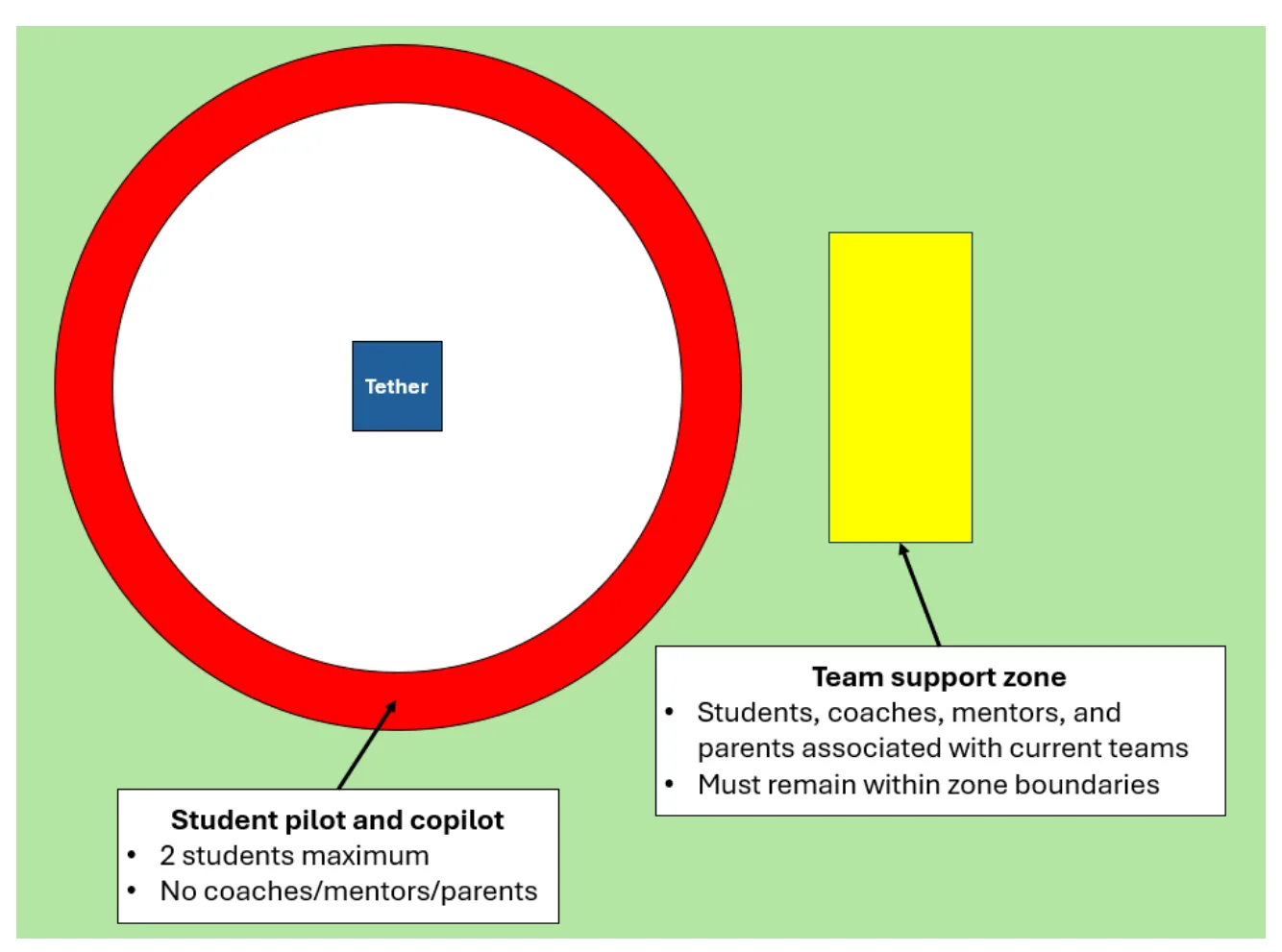
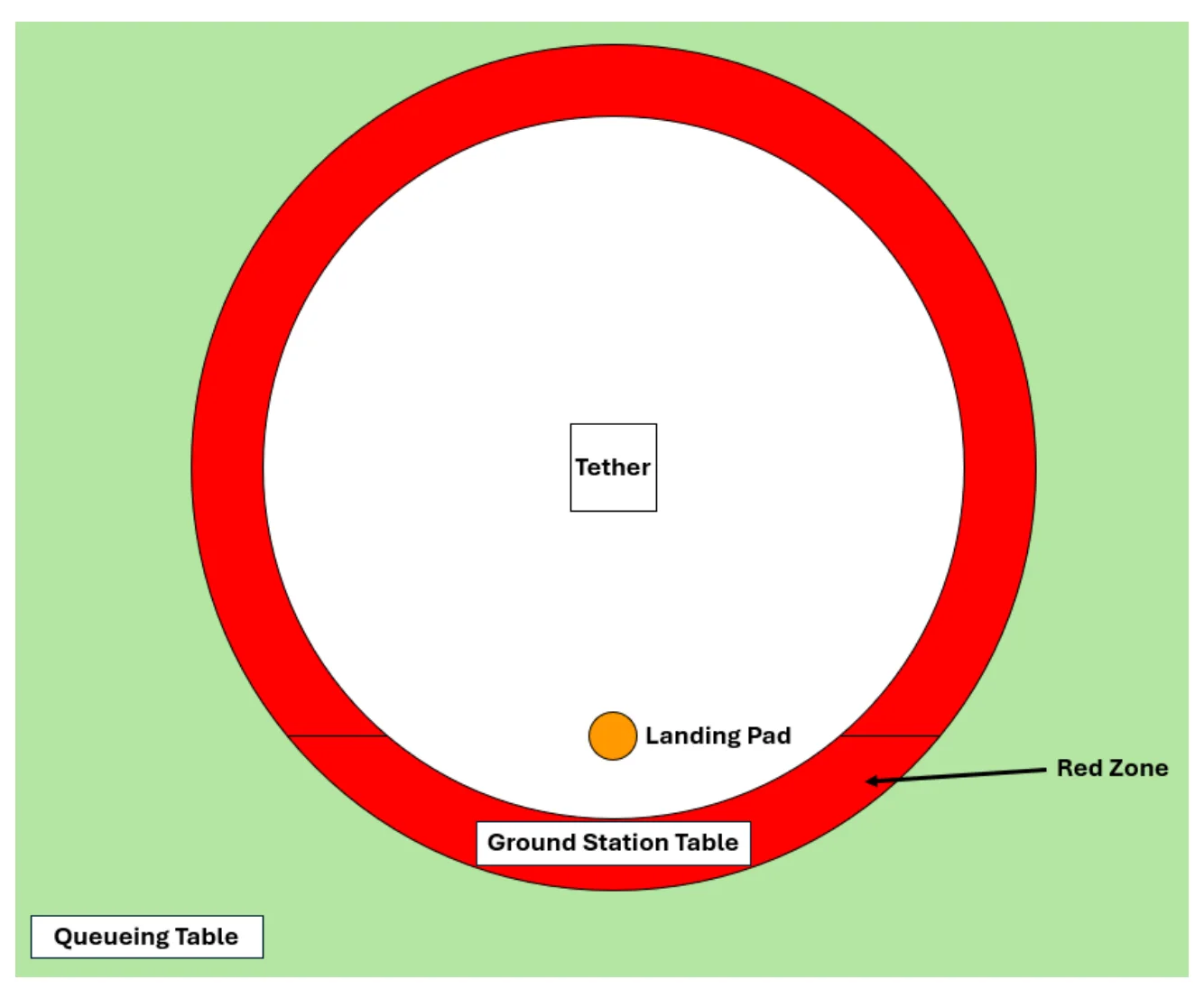
Figure 2.1 below shows the flying field boundaries. These boundaries will be marked with soccer cones (or similar items) and keep all personnel outside of the drone tether range. The red zone around the field is for the pilots and copilots of the current round only. Their teammates, coaches, mentors, and parents/guardians may spectate from the team support zone. Students and spectators from other teams not currently participating must stay outside of both zones and should watch from either the bleachers or the team pits. See Section 5.2 for details on this rule.
Team technical and ethical presentations are completed indoors. A projector will be provided, and the judging panel will display the teams’ virtually-submitted presentation slides.
2.2Team Roles#
Teams comprise of students and a coach, and they may also be supported by mentors, parents/guardians, school administrators, friends, and more. Table 2.1 gives further details about the roles and requirements of each team.
| Role | # | Requirements | Recommendations |
|---|---|---|---|
| Team Captain | 1 (Req’d) |
|
|
| Teammate | 1-4 (Rec’d) |
| |
| Pilot | 1 (Req’d) |
|
|
| Copilot | 1 (Req’d) |
|
|
| Coach | 1 (Req’d) |
|
|
2.3Event Schedule#
See Table 2.2 below for an example Regional Competition event schedule. Exact event schedules will be distributed to teams at the competition. Competition start and end times will be emailed to teams at least 1 week before their Regional Competition. Teams should anticipate competitions beginning as early as 7 a.m. and ending as late as 5 p.m. Times will vary based on factors such as the number of teams competing and venue size.
| Time Block | Event | Approx. Start | Notes |
|---|---|---|---|
| 0 | Setup | 5:30 a.m. | Volunteers set up venue. Teams may not enter premises until check-in begins. |
| 1 | Team Check-In | 7:00 a.m. | Teams MUST check in before participating. |
| 2 | Opening Ceremony | 8:00 a.m. | |
| 3 | Tech. Inspection | 8:15 a.m. | Teams MUST complete Tech. Insp. before flying. |
| 4 | Mission 1 Rounds Tech. Presentations | 8:30 a.m. | Mission 1 & Tech. Pres. occur simultaneously. Each team will receive at least 15 minutes between any events on their individual schedule. |
| 5 | Lunch | 11:30 a.m. | Free lunches for all registered students and coaches. |
| 6 | Mission 2 Rounds | 12:15 p.m. | |
| 7 | Score Calculations | 4:30 p.m. | Volunteers calculate final scores. |
| 8 | Closing Ceremony | 4:45 p.m. | Awards presented. |
| 9 | Cleanup | 5:00 p.m. | Volunteers clean up event/venue. Teams may assist if desired. |
2.4Season Schedule#
See Table 2.3 below for the 2025-2026 season schedule. Note that the ARC season begins in the fall and includes virtual tasks throughout the season. All deadlines are final, so be sure to complete all submissions in a timely manner.
| Date | Event | Location | Notes |
|---|---|---|---|
| Sept 11, 2025 | Information Session #1 | Virtual (stemed.org/events) | Anyone interested in ARC may attend an Information Session to learn more. |
| Sept 20 | Information Session #2 | ||
| Oct 4 | Kickoff & Rulebook Release | Varies by region | Teams will receive further information upon registration. |
| Oct 25 | Coach Training | Virtual (stemed.org/events) | All coaches and mentors are welcome to attend. |
| Nov 24 | Registration Due | stemed.org/registration | If you wish to participate in the 2025-26 season, registration paperwork and fees must be completed by this date. |
| Registration Fee Due | |||
| Jan 31, 2026 | Accountability Task #1 | stemed.org/arc- | See Section 3.4 for task descriptions. |
| Feb 21 | Accountability Task #2 | ||
| Feb 28 | Accountability Task #3 | ||
| submissions | |||
| Apr 4 | Accountability Task #4 | ||
| Apr 11 | Student Waivers DUE | Legally required for student participation. | |
| TBD | Antelope Valley Reg. Comp. | Little Rock High School | Teams will receive further information throughout the season from their respective regional coordinator. |
| TBD | Mid-Atlantic Reg. Comp. | Flint Hill School | |
| TBD | Silicon Valley Reg. Comp. | TBD | |
| April 25 | San Diego Reg. Comp. | Escondido Charter High School | |
| May 9 | New England Reg. Comp. | Saint Anselm College | |
| TBD | Indiana Reg. Comp. | Purdue University | |
| May 29-30 | National Competition | Saint Anselm College | Invitational event. |
2.5Eligibility Requirements#
2.5.1Season Participation Eligibility#
To participate in the ARC season, which includes submitting Accountability Tasks, accessing volunteer assistance through virtual office hours, and competing in a Regional Aerospace Robotics Competition, teams must complete all registration tasks by November 24, 2025.
Registration includes two components, each of which must be completed by the team coach:
- Submit the registration form: stemed.org/registration
- Pay the registration fee: stemed.org/registration
Remember that all deadlines are final. Please reach out as soon as possible with any questions or concerns.
Registration enables teams to participate in the season, but additional tasks must be completed to compete in the Regional Competition:
- All students must have a waiver completed by their parent/guardian submitted through WaiverSign (see Figure below) by Saturday, April 11, 2026, in order to participate at the flying field or in photographs.
- Teams must also submit Pre-Competition Surveys and attend their Regional Pre- Competition Briefing; further details will be provided by teams’ respective Regional Coordinators.
Additionally, all teams must be able to pass the Technical Inspection (see Appendix B: Technical Inspection Rubric), including registering their drone with the FAA and bringing a physical copy of the pilot’s TRUST Exam Certificate, to compete in any flying portions of the competition.
Teams must provide a budget spreadsheet to compete (see Section 4.1.5).
If teams are ineligible to compete in flying portions of the competition, they are still encouraged to complete their Technical Presentation. If teams are ineligible to compete in any portion of the competition, they are encouraged to attend as spectators to enjoy the learning experience.
2.5.2National Competition Eligibility#
All Regional Competition Eligibility Requirements also apply for the National Competition. Additionally, teams must receive a 2026 National Competition Invitation from their Regional Event and RSVP within 7 days of receiving the invitation.
Teams who do not RSVP within 7 days, or who decline the invitation, will forfeit their spot on the roster. The invitation will then be offered to the next eligible team from the respective region. There is no additional registration fee to attend the National Competition, but teams are responsible for their own travel expenses.
32025-26 Season Challenges#
The 2025-26 season will include 2 flight missions, a collection of virtual tasks, a technical presentation, and an ethical presentation. See the following sections for details on each portion.
During each flight mission, teams will be assigned a color: Orange or Blue. Color assignments will be included on the competition schedule, and teams will be queued by color. This assignment is randomly selected, and it is solely used for queueing and determining which color objects a team will be using.
See following subsections for diagrams to clarify each task.
3.1Component Descriptions#
Table 3.1 below lists the components used for flight missions, along with the acronyms used to label them. See 2025-26 Field Kit Assembly Guide for a detailed guide on building an official competition field, along with recommendations for affordable alternative components for practice.
| Name | Acronym | Description | Representative Item on Field |
|---|---|---|---|
| Payload 1 | P1 | Lifesaver | Lifesaver |
| Payload 2 | P2 | Turtle | Stuffed Turtle |
| Payload 3 | P3 | Whale Tracker | Foam Puck |
| Field Component 1 | FC1 | Pool | Pool |
| Field Component 2, Red | FC2 R | Swimmers | Colored Boards, Hanging Basket |
| Field Component 2, Blue | FC2 B | ||
| Field Component 3, Blue | FC3 B | Whales | Colored Boards |
| Field Component 3, White | FC3 W | ||
| Field Component 3, Purple | FC3 P | ||
| Field Component 4 | FC4 | Landing Pad | Landing Pad |
| Field Component 5 | FC5 | Tether | Tether Block and Cable |
| Mission Equipment 1 | ME1 | Ground Station | Table |
| Mission Equipment 2 | ME2 | Queueing Location | Table |
| Mission Equipment 3 | ME3 | Camera | Camera |
3.2Mission 1: You’re a Lifesaver#
Every year, nearly 4,000 boating accidents strike across the United States, along with countless floods and natural disasters that leave lives hanging in the balance. In these high-risk situations, search and rescue teams step into danger to save others. But what if technology could take their place?
This competition challenges you to do exactly that. Your mission: engineer a rescue drone capable of locating and aiding survivors in treacherous waters. This drone must be fast, precise, and reliable under pressure. The stakes are real: in the field, lives depend on speed, accuracy, and innovation. Only the best designs will rise to the top. Will your team’s drone prove ready for the future of rescue operations – or sink under the challenge?
Your mission is to identify a stranded swimmer, drop a lifesaver, and pull the swimmer to safety. If your team is prepared for an advanced challenge, tasks may be completed using autonomy and computer vision. Ideally, we wish to precisely lower the lifesaver to the swimmer and tow them to shore; however, teams may also consider dropping the lifesaver near the swimmer instead. This is more difficult for the swimmer to retrieve, but it is an easier task to complete. While strategizing, consider the drone’s capabilities, time and funding constraints, and your team’s coding proficiency to determine which challenges to tackle.
This section will provide detailed instructions for completing this mission.
3.2.1Tasks#
Your mission consists of the following tasks:
- View swimmers (FC2):
- Take off from FC4.
- Use drone-mounted camera to view swimmers.
- Transmit footage to laptop computer or handheld monitor.
- Identify swimmer in need (FC2 R ):
- Use camera feed to determine which swimmer is in need.
- Teams may visually identify the swimmer through the camera feed (fewest points), or they may use a computer vision program* to autonomously identify the swimmer (most points).
- Drop lifesaver (P1) to swimmer in need (FC2 R ):
- P1 is preloaded before the match.
- P1 may be delivered by being:
- Dropped/lowered into FC1 on a line (most points).
- Note: This task is a prerequisite for completing Task 4.
- Teams may use any line. No line will be provided at the competition.
- Dropped freely into FC1 without a line.
- Dropped within ten feet of FC1 (fewest points).
- Pull swimmer (FC2 R ) to safety (outside of FC1):
- Hook P1 around FC2 R.
- Drag FC2 R to any location outside of FC1.
- End round on landing pad (FC4):
- Touching any part of FC4 will be considered successfully landing on it.
Each of the above tasks may be completed autonomously or semi-autonomously. Teams may choose to complete some tasks semi-autonomously and some autonomously. For example, a team may choose to take off and fly over the targets semi-autonomously, then prompt the drone to autonomously run a computer vision program and drop the lifesaver, then finally regain semi-autonomous control to rescue the swimmer and land. The pilot/copilot should communicate with the Flight Judge throughout the round to announce and demonstrate when a task is being performed autonomously.
In the event of poor weather conditions, Regional Directors may choose to hold one or more flight rounds indoors. For indoor flights, teams MUST perform takeoff and landing (Tasks 1 and 5) semi-autonomously. Tasks 2 through 4 may still be completed autonomously or semi-autonomously.
3.2.2Mission Schedule#
Each round of Mission 1 will be 10 minutes. The Field Manager shall count down from three to begin the round. This countdown will begin when the team has attached the tether, connected the battery, armed the drone, and stepped back into the Red Zone. Any other piloting tasks, including connecting computers/monitors and starting autonomous programs, will be counted in the allotted 10 minutes.
Teams will be scheduled to complete at least one, and up to three, rounds of Mission 1. All teams at the event will be scheduled to complete the same number of rounds. If multiple rounds of Mission 1 take place, teams will be given a final score equal to the maximum of all round scores.
3.2.3Field Layout#
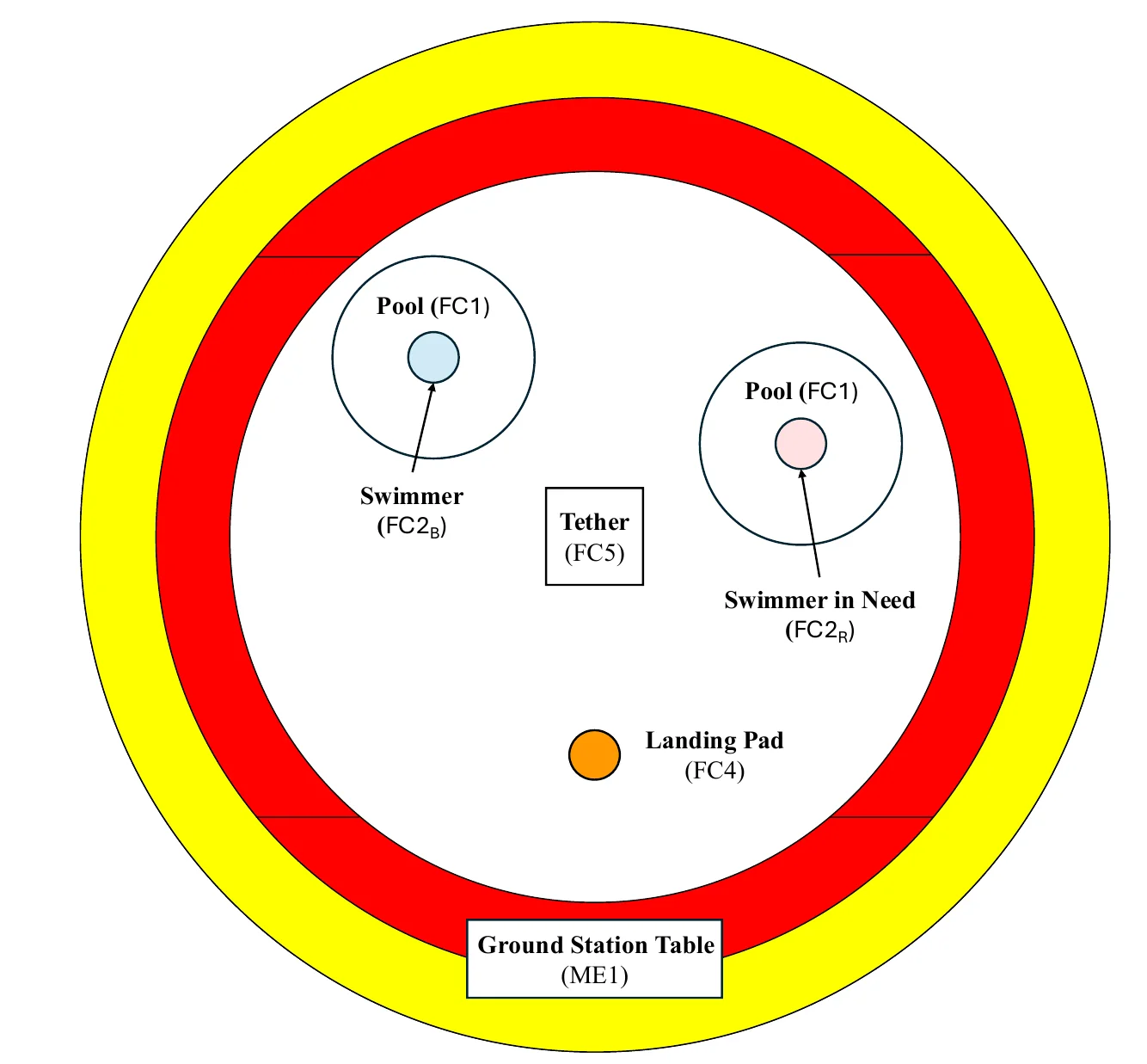
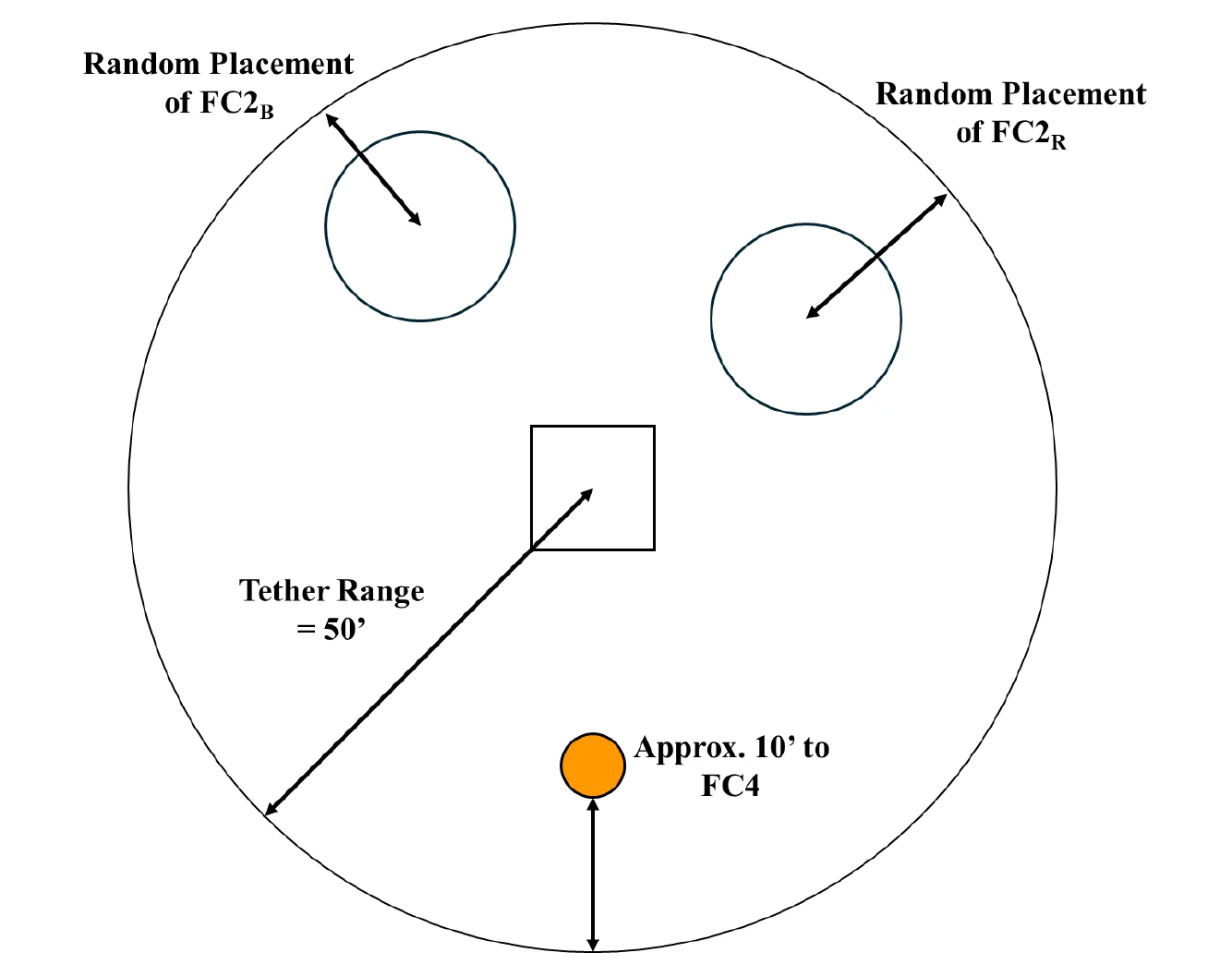
The following figures provide field diagrams. See Figure 3.1 for the placement of each item on the field. See Figure 3.2 for measurements of item placement (figure not to scale).
Notes:
- Many items have approximate location callouts, indicating variability in field setups.
- “Random Placement” items will be located in the same half of the field shown in field diagrams, but no measurements are indicated.
- Teams are advised to practice using various configurations to prepare for all possibilities.
3.3Mission 2: Savior of the Seas#
Across the world, thousands of sea turtles wash ashore, stranded and vulnerable, while whale populations migrate vast distances without researchers able to follow their every move. Conservationists work tirelessly to respond, but the ocean is vast, and their reach is limited. What if advanced drone technology could extend their efforts to rescue and monitor our sea creatures?
Your challenge is to engineer a marine rescue and research drone system capable of performing two critical tasks: assisting stranded turtles and safely tagging whales for migration studies. Drones must carefully lift each stranded turtle and place it into the ocean. They must also use a camera to identify whales and tag the correct species.
This is more than just a drone mission – it is a chance to demonstrate ethical engineering in action by collaborating with another conservationist group. Teams will work together to tag whales, while also being allowed to recover stranded turtles from the opposing side of the field to ensure that no animal is left behind.
This section will provide detailed instructions for completing this mission.
3.3.1Tasks#
Your mission consists of the following tasks:
- Rescue stranded turtles (P2):
- Lift P2 and deliver into FC1.
- Each side of the field (orange and blue) will have six turtles (P2) to rescue. Teams may rescue turtles from the opposing side of the field IF they have successfully rescued all six from their assigned side.
- Teams MAY NOT attempt to interact with the opponent’s turtles until they have rescued all six of their assigned turtles.
- Teams MUST yield to their opponent when flying on the opponent’s side of the field. For example, if the blue team has scored all six of their turtles, they may begin to score turtles from the orange team’s side of the field. However, if both teams are attempting to pick up the same turtle, the blue team MUST yield and allow the orange team to rescue their own turtle.
- Teams are expected to remain sportsmanlike at all times, and Field Managers may give penalties for conduct that may reasonably be deemed unsportsmanlike, including guarding turtles to prevent the opponent from collecting them.
- Tag whales (FC3):
- Carry P3.
- Teams may use a mechanism to lift tags from the ground, or they may preload one or more tags onto their drone before beginning the match.
- Use a camera to identify each species of FC3.
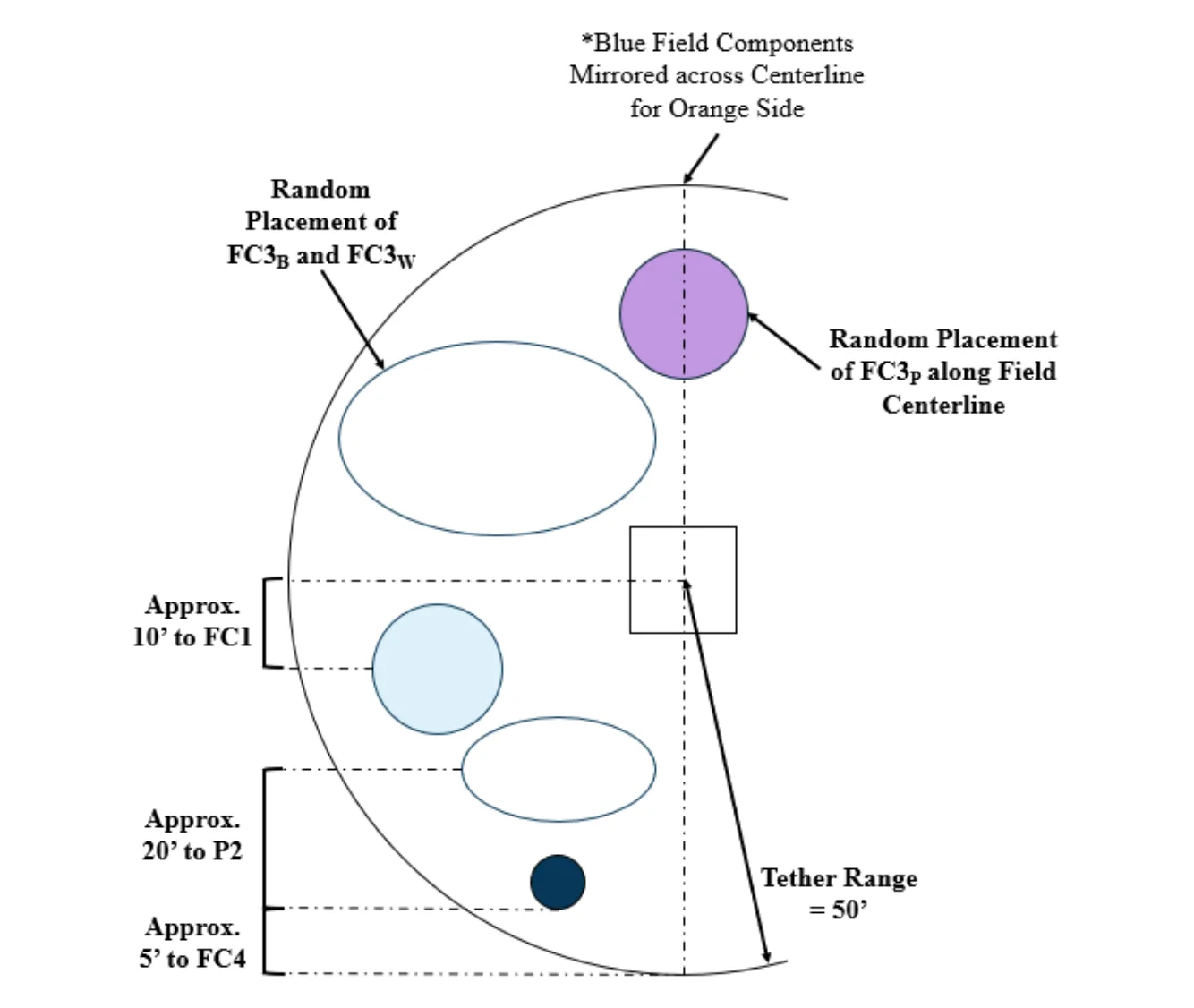
- The field will contain three species of whales: Blue (FC3 B ), White (FC3 W ), and Purple (FC3 P ). Each side of the field will have two of each FC3 B and FC3 W , and the teams will share one FC3 P placed along the centerline of the field.
- Place P3 onto 2x FC3 B and 1x FC3 P .
- If both teams on the field place P3 onto FC3 P , each team will be awarded an additional score for collaboration.
- Instead of placing a tag, teams may choose to land on 2x FC3 B and 1x FC3 P for fewer points.
- Avoid interfering with FC3 W .
- A penalty will be awarded for landing on FC3 W .
- A penalty will be awarded for dropping a whale tag on FC3 W.
- End round on landing pad (FC4):
- Touching any part of FC4 will be considered successfully landing on it.
3.3.2Mission Schedule#
Each round of Mission 2 will be 7 minutes. The Field Manager shall count down from three to begin the round. This countdown will begin when the team has attached the tether, connected the battery, armed the drone, and stepped back into the Red Zone.
Teams will be scheduled to complete at least one, and up to three, rounds of Mission 2. All teams at the event will be scheduled to complete the same number of rounds. If multiple rounds of Mission 2 take place, teams will be given a final score equal to the maximum of all round scores.
3.3.3Field Layout#
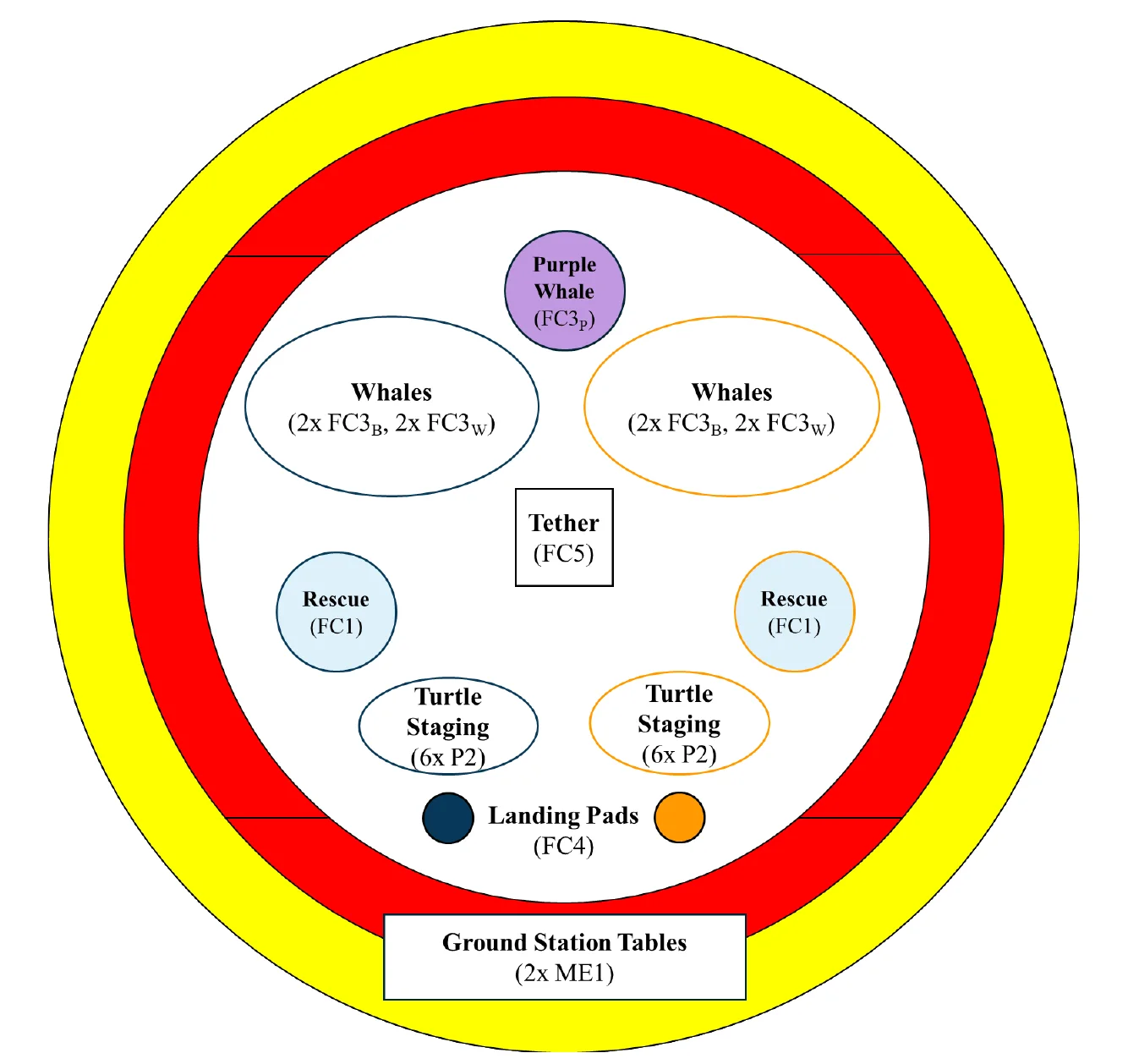
The following figures provide field diagrams. See Figure 3.3 for the placement of each item on the field. See Figure 3.4 for measurements of item placement (figure not to scale). Note that both drones will be piloted from the same side of the field. Any attempt to interfere with an opponent’s operations will result in immediate disqualification from both Missions 1 and 2.
Notes:
- Many items have approximate location callouts, indicating variability in field setups.
- “Random Placement” items will be located in the same half of the field shown in field diagrams, but no measurements are indicated.
- Teams are advised to practice using various configurations to prepare for all possibilities.
3.4Virtual Missions#
The following missions are to be completed virtually. These missions must be submitted through the STEM-ED INC website: stemed.org/arc-submissions.
- TRUST Exam: Submit TRUST Exam certificates.
- Note that pilots MUST have a TRUST Exam certificate to legally fly at the competition (see Section 4.2).
- Power On: Submit video of team powering on drone.
- Takeoff and Land: Submit video of drone taking off and landing.
- Autonomously or semi-autonomously.
- Mechanism Prototype: Submit video demonstrating a mechanism prototype.
- Does not need to be attached to drone.
- May be moved by hand.
- Drop Object from Air: Submit video of drone dropping item from air.
- Drone must be in flight.
- Any payload.
- May preload item.
- Camera Operation: Submit video of student reading a number off camera feed monitor from data transmitted via camera.
- Provide video of drone as well as of camera feed monitor during flight.
- This does not need to be completed with the official camera dictated in Section 4.1.6. Teams may use any camera and monitor to complete this Mission.
- Autonomous Waypoints: Create a flight path of 3 waypoints and submit video of drone autonomously flying path.
- Provide video of drone as well as of ground station during flight.
- Color Recognition: Submit video of computer vision program successfully identifying a red object, along with text file of code.
- May use Python or C++ code.
- Register Drone through FAA: Submit screenshot of completed drone registration.
- Note that drones MUST be registered with the FAA to legally fly at the competition (see Section 4.2).
- Budget: Submit budget spreadsheet.
- Must comply with limits listed in Section 4.1.5.
- Note that this is a REQUIRED task to compete.
Missions are due in 4 stages:
- Accountability Task 1: Submit Virtual Mission 1
- Due: January 31, 2026
- Accountability Task 2: Submit Virtual Missions 2-3
- Due: February 21, 2026
- Accountability Task 3: Submit Virtual Mission 4
- Due: February 28, 2026
- Accountability Task 4: Submit Virtual Missions 5-10
- Due: April 4, 2026
Accountability Tasks 1 through 3 may be submitted late for a 50% point reduction. Submissions will be accepted through April 4, 2026 (Accountability Task 4 due date).
3.5Flight Procedure#
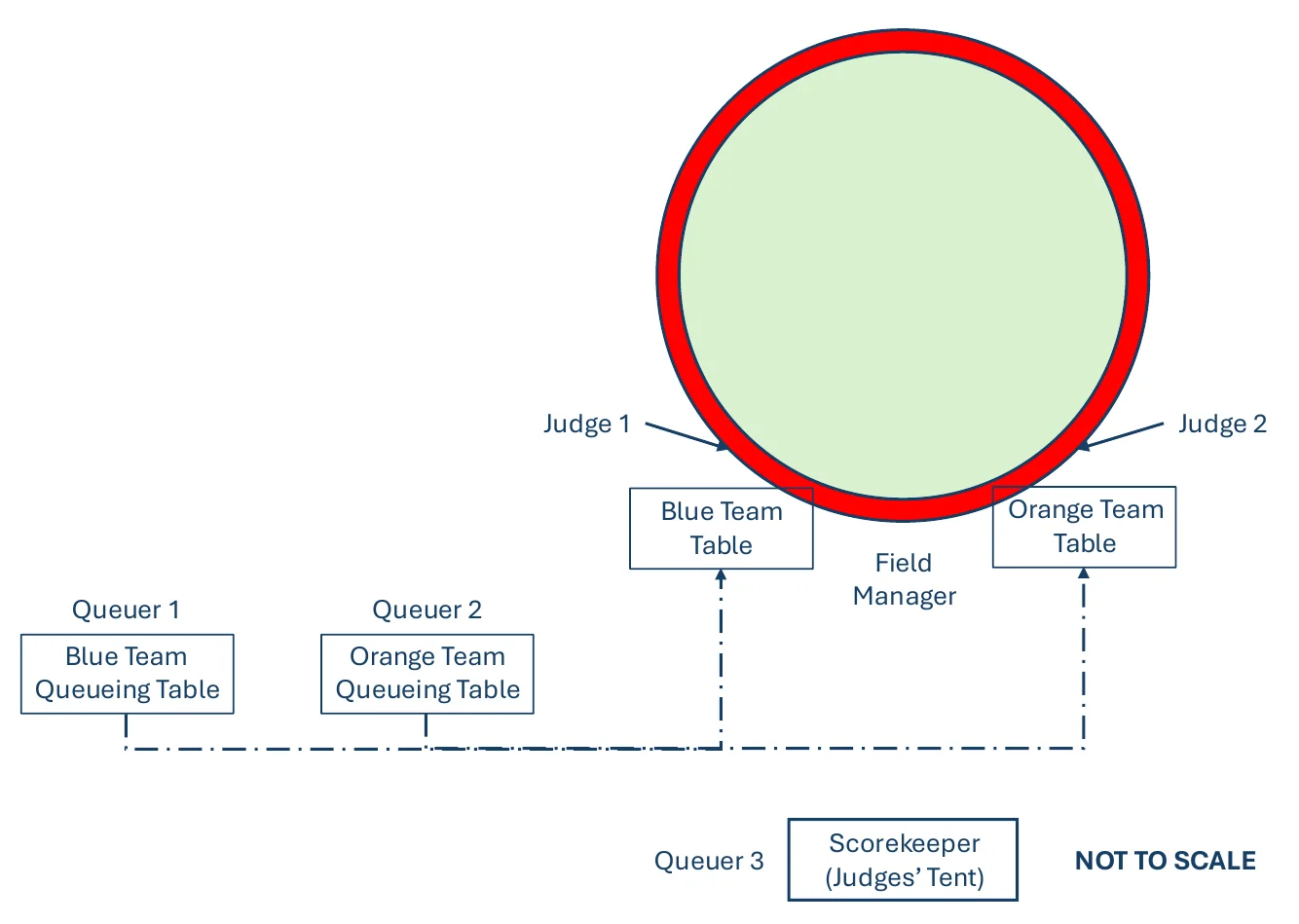
Flight portions of the competition will follow the process below (see Figure 3.5 for location references). Please note that the Field Manager will be directing all major steps, and teams must wait for his/her instruction before completing these steps. The Field Manager is also responsible for safety and final rulings. Teams are expected to obey Field Manager directions, including to activate the Kill Switch immediately when commanded.
Teams must arrive at the Queueing Table at least 5 minutes before their round is scheduled to begin. Teams who do not arrive to their round during their allotted time slot will forfeit their match and will not be given an opportunity to complete it at a later time.
| Step | Action | Location | Note |
|---|---|---|---|
| 1 |
| Queueing Table | 5 minutes before match time. |
| 2 |
| Red Zone | Must wait for direction of Field Manager. |
| 3 |
| Ground Station Table & Landing Pad | |
| 4 |
| Landing Pad, Ground Station Table | Must wait for direction of Field Manager. |
| 5 |
| Ground Station Table | |
| 6 |
| Ground Station Table | Must wait for direction of Field Manager. |
| 7 |
| Ground Station Table | |
| 8 |
| ||
| 9 |
| Must land IMMEDIATELY when time ends. | |
| 10 |
| Ground Station Table | |
| 11 |
| Field | Must wait for direction of Field Manager. |
| 12 |
| Field | MUST unplug battery first. |
| 13 |
| Ground Station Table |
3.6Technical Presentation#
Designing, building, testing, debugging, and flying are all useful skills; however, if an engineer cannot effectively communicate their ideas, the ideas are unusable. Thus, learning to create and deliver a technical presentation, along with supporting spreadsheets, is vital.
Your task is to use professional communication concepts to document and present your work. The following sections detail the requested information; note that some points are open to interpretation, and teams are encouraged to be creative when deciding how to display their results. If desired, teams may also include additional information not included in the rubric. Presentations should be given entirely by students without the assistance of coaches, mentors, or parents/guardians.
3.6.1Team Logistics#
- Team organization and dynamics:
- List of team members and their roles
- Photo(s) of team
- Details on meeting style
- Team schedule for project completion:
- Task breakdown
- Team member(s) responsible for each task
- Planned time of completion for each task
- Actual time of completion for each task
3.6.2Engineering Process#
- Software methodology:
- Software chosen and why (if applicable)
- Ground station chosen and why (if applicable)
- Waypoint navigation strategy
- Camera feed setup
- Mission overview and strategy:
- Method of choosing tasks to complete
- Strategy of completing missions
- Mechanism design:
- Design process
- Early designs/prototypes vs final result
3.6.3Final Product#
- Vehicle overview:
- Labelled images of drone and mechanism
- View of entire system (front, top, side, isometric views), with primary dimensions (height, width, depth) clearly labelled
- Electronics diagram:
- Layout of major electronics systems (flight controller, speed controllers, motors, etc.)
- Product success:
- Flight test results
- Projected competition score
3.6.4Presentation Style#
- Slides are legible and clear:
- Text size and color choices allow judges to easily read slides
- Text, photos, and labels are placed to avoid crowding/overlapping
- Presenters are professional and well-prepared:
- Minimal mannerisms such as “um” and “you know”
- Presenters are ready to speak about assigned subjects/slides
- All team members speak:
- Each student team member is actively involved in presentation
- Q&A responses:
- Team professionally answers all questions from judges
*Note that judges will understand presenter limitations due to disabilities. Presenters will be judged according to individual preparedness and efforts.
3.6.5Procedure#
- Submit Slides:
- Teams are to virtually submit their Technical Presentation Slides by midnight 7 days before their Regional Competition (stemed.org/arc-submissions)
- If teams submit multiple times, the most recent submission prior to the deadline will be used by the Technical Presentation Judges
- Setup:
- Judges project submitted slide deck onto screen
- Team sets up desired display materials
- Presentation:
- Team presents for up to 10 minutes
- Judges raise hand to signify 1 minute remaining
- Q&A:
- Judges ask relevant questions to students for up to 5 minutes
- Students answer questions as they deem fit
- Cleanup:
- Team gathers belongings and exits
- Next team begins setup
3.7Ethical Presentation#
Drones are powerful devices with seemingly limitless applications, ranging from environmental monitoring and disaster relief to agriculture and national security. However, with such potential comes an equally great responsibility. A critical aspect of engineering is not only designing advanced technologies but also carefully determining their ethical uses.
Engineers possess the skills and creativity to develop innovations that can transform the world for the better, but doing so requires more than technical expertise alone. It demands a thoughtful and heartfelt commitment to engineering ethics—an awareness of how each design choice, application, and deployment impacts people, societies, and the environment. By grounding their work in ethical responsibility, engineers ensure that technology remains a tool for positive progress rather than unintended harm.
STEM-ED INC is challenging YOU to consider how to use your developing skills for the betterment of our world.
3.7.1Grading#
See Appendix A for the Ethical Presentation Rubric. See Section 3.7.2 to further understand the process of this presentation. Note that some points are open to interpretation, and teams are encouraged to be creative in their responses.
- Academic Validity:
- Explanation of theory/doctrine: o Present proposed solution to ethical dilemma o Discuss theory/doctrine behind this decision
- Programming the drone: o Describe programming to achieve the proposed solution
- Comprehension and Elocution:
- Comprehension: o Demonstrate clear understanding of the problem and why engineering ethics would be critical in this situation
- Elocution: o Deliver information in a comprehendible and professional manner
- Discussion:
- All speak and demonstrate inclusion
- Students demonstrate respect during disagreements
- Students value one another’s ideas*
- Note: teams will not be graded on the content of this discussion, only the collaborative efforts. Thus, students should feel free to communicate and not fear suggesting “wrong” answers during this discussion.
- Q&A Responses:
- Team professionally answers all questions from judges
*Note an important concept for students to learn: in engineering, the best way to come together and select the best solution is by viewing everyone as a cohesive unit. Do not focus on “my idea,” but instead seek “our progress” in discussions.
3.7.2Process#
Teams will be put into a similar setting as the Technical Presentation; however, this presentation will involve answering an ethical dilemma posed by the judges. Teams will be given time to prepare a response, then they will present this response to the judges.
As in the Technical Presentation, presentations should be given entirely by students without the assistance of coaches, mentors, or parents/guardians.
- Setup:
- Team enters room and stands in designated area
- It is highly recommended that teams bring paper and writing utensils to assist in the discussion portion. If available, judges will provide a whiteboard, but this will vary by venue and should not be expected.
- Question:
- Judges provide ethical dilemma to team
- Discussion:
- Students may discuss this question together for up to five minutes
- This discussion will take place in front of judges, but it will only affect the discussion portion of their grading on the rubric
- Presentation:
- Students may present for up to five minutes
- Students should answer the ethical dilemma in a manner that fulfills the grading
requirements o Note that some requirements are open-ended to encourage creativity
- Q&A:
- Judges ask relevant questions to students for up to 5 minutes
- Students answer questions as they deem fit
- Cleanup:
- Team gathers belongings and exits
- Next team begins setup
Students may not discuss the ethical question with other teams until all teams have completed their Ethical Presentation.
3.8Scoring Equations#
3.8.1Possible Scores#
The following tables provide the maximum possible scores for each task.
| # | Task | Score | # Possible | Total Score |
|---|---|---|---|---|
| 1 | View either swimmer through camera feed | 100 | 1 | 100 |
| 2a | Identify swimmer in red autonomously using computer vision program | 400 | 1 | 400 |
| 2b | Identify swimmer in red semi-autonomously through camera feed | 100 | 1 | 100 |
| 3a | Drop lifesaver attached to line into correct pool | 150 | 1 | 150 |
| 3b | Drop lifesaver freely into correct pool | 100 | 1 | 100 |
| 3c | Drop lifesaver within 10’ of correct pool | 50 | 1 | 50 |
| 4 | Pull swimmer to safety with lifesaver | 300 | 1 | 300 |
| 5 | End round on landing pad | 50 | 1 | 50 |
| P1 | Drop lifesaver into incorrect pool | -100 | 1 | -100 |
| Total | 1,000 |
| # | Task | Score | # Possible | Total Score |
|---|---|---|---|---|
| 1 | Lift a turtle | 100 | 1 | 100 |
| 2 | Deliver turtle into pool | 50 | 12 | 600 |
| 3 | Lift a whale tag | 50 | 1 | 50 |
| 4a | Drop tag onto blue whale, camera used to identify | 200 | 2 | 400 |
| 4b | Drop tag onto blue whale, no camera used | 150 | 2 | 300 |
| 4c | Land on blue whale | 50 | 2 | 100 |
| 5 | Drop tag onto purple whale | 150 | 1 | 150 |
| 6 | Both teams drop tag onto purple whale | 150 | 1 | 150 |
| 7 | End round on landing pad | 50 | 1 | 50 |
| P1 | Land on white whale | -50 | 2 | -100 |
| P2 | Drop tag onto white whale | -50 | 2 | -100 |
| Total | 1,500 |
| # | Mission | Notes | Total Score | |
|---|---|---|---|---|
| 1 | TRUST Exam | AA TRUST Exam Certificate submitted for each student on roster. | Legally required for pilot to carry TRUST Exam Certificate while flying. | 25 |
| 2 | Power On | Power on drone. | 50 | |
| 3 | Takeoff and Land | Takeoff and land. | May be completed autonomously or semi-autonomously. | 100 |
| 4 | Mechanism Prototype | Demonstrate mechanism prototype. | Does not need to be attached to drone. May be moved by hand. | 100 |
| 5 | Drop Object from Air | Drop any item from air. | Drone must be in flight. May use any payload. Payload may be preloaded. | 100 |
| 6 | Camera Operation | Read a number off camera feed monitor from data transmitted via camera. | 100 | |
| 7 | Autonomous Waypoints | Create a flight path of 3 waypoints and autonomously fly path. | 150 | |
| 8 | Color Recognition | Successfully identify a red object using computer vision program. | May use Python or C++. Must provide text file of code. | 300 |
| 9 | Register Drone | Register drone through AA. | This number MUST be displayed on drone during flight. | 25 |
| 10 | Budget | Budget spreadsheet. |
| 50 |
| Total | 1,000 |
| # | Task | Score |
|---|---|---|
| 1 | Team organization and dynamics | 50 |
| 2 | Team schedule | 50 |
| 3 | Software methodology | 100 |
| 4 | Mission overview and strategy | 100 |
| 5 | Mechanism design | 100 |
| 6 | Vehicle overview | 100 |
| 7 | Electronics diagram | 100 |
| 8 | Product success | 100 |
| 9 | Legible/clear slides | 100 |
| 10 | Professional and well-prepared | 50 |
| 11 | All team members speak | 50 |
| 12 | Q&A responses | 100 |
| P1 | Team continues presenting after time is called | -100 |
| Total | 1,000 |
| # | Task | Score |
|---|---|---|
| 1 | Explanation of theory/doctrine | 100 |
| 2 | Programming the drone | 50 |
| 3 | Comprehension | 50 |
| 4 | Elocution | 50 |
| 5 | All speak and demonstrate inclusion | 50 |
| 6 | Students demonstrate respect during disagreements | 50 |
| 7 | Students value one another’s ideas | 50 |
| 8 | Q&A responses | 100 |
| P1 | Team continues presenting after time is called | -50 |
| Total | 500 |
| Mission | Action* | Value |
|---|---|---|
| Mission 1, Mission 2 | Unintentional collision with opponent. | DQ from all Rounds of Mission |
| Intentional collision with opponent. | DQ from Competition | |
| Technical Presentation | Presentation continues after time is called | -50 |
*Actions and intentions as deemed by Field Manager.
| Mission | Score |
|---|---|
| Virtual Tasks | 1,000 |
| Mission 1 | 1,000 |
| Mission 2 | 1,500 |
| Technical Presentation | 1,000 |
| Ethics Presentation | 500 |
| Total | 5,000 |
4Drone Requirements#
4.1Mechanical Requirements#
The UAV must meet all requirements listed below to be eligible for flight. The UAV will be inspected at the competition prior to flight (see Appendix B: Technical Inspection Rubric).
All components must also remain within the budget allowances shown in Table 4.1. Teams will be required to present their list of components and prices during the technical inspection. Note that components/kits suggested by STEM-ED INC will meet all financial requirements.
See Section 4.1.6 for component recommendations.
All designing, building, coding, and testing is to be completed by students only. Teams may request guidance from adult coaches and mentors, but all hands-on work and major decisions should be completed by students only.
Drones MUST have a kill switch to immediately cut the drone’s motors in case of emergency. Please visit youtube.com/@aerospaceroboticscomp501c3 for assistance if needed.
4.1.1Structure#
Teams must create a drone structure that fits within size and component limitations:
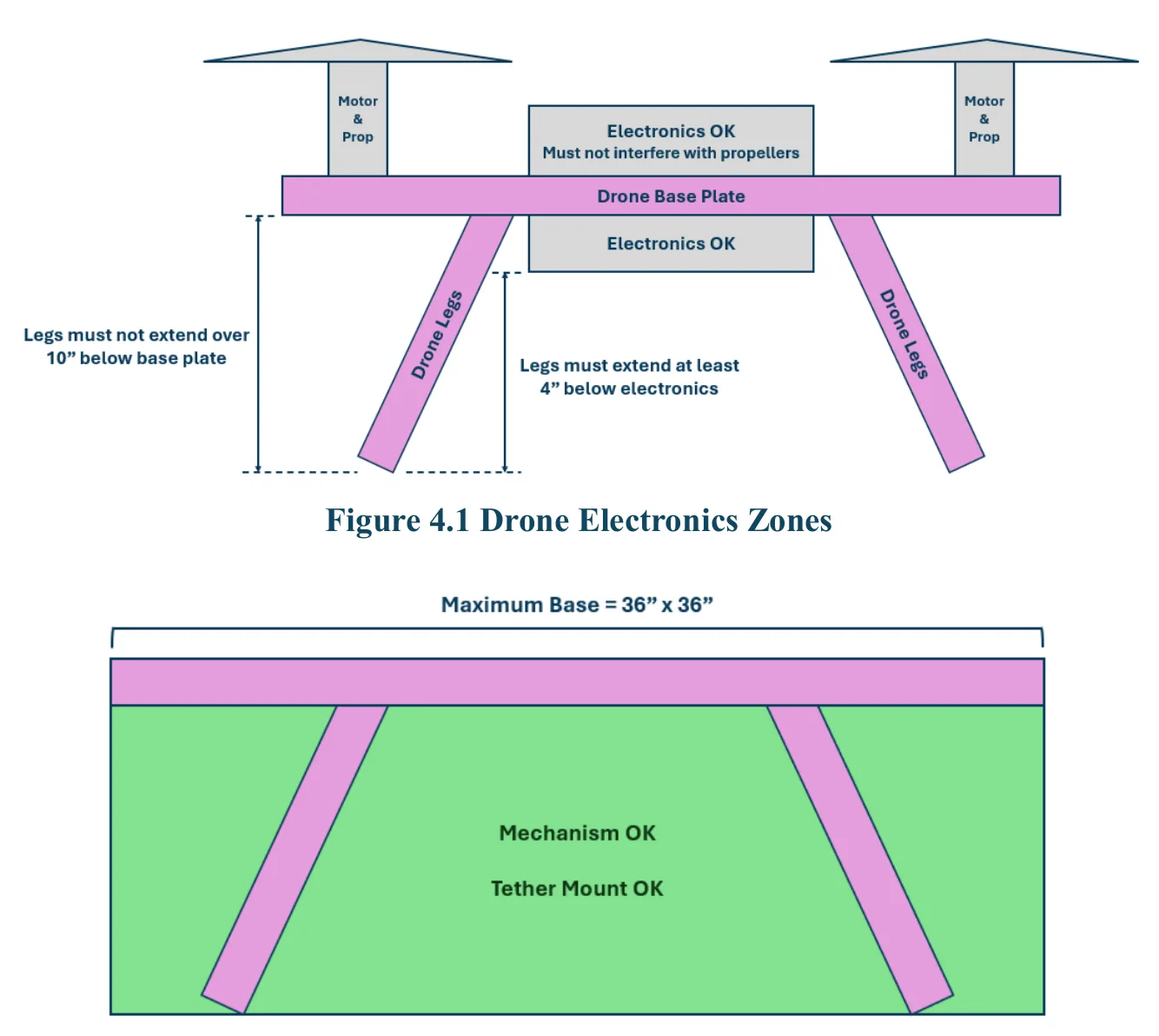
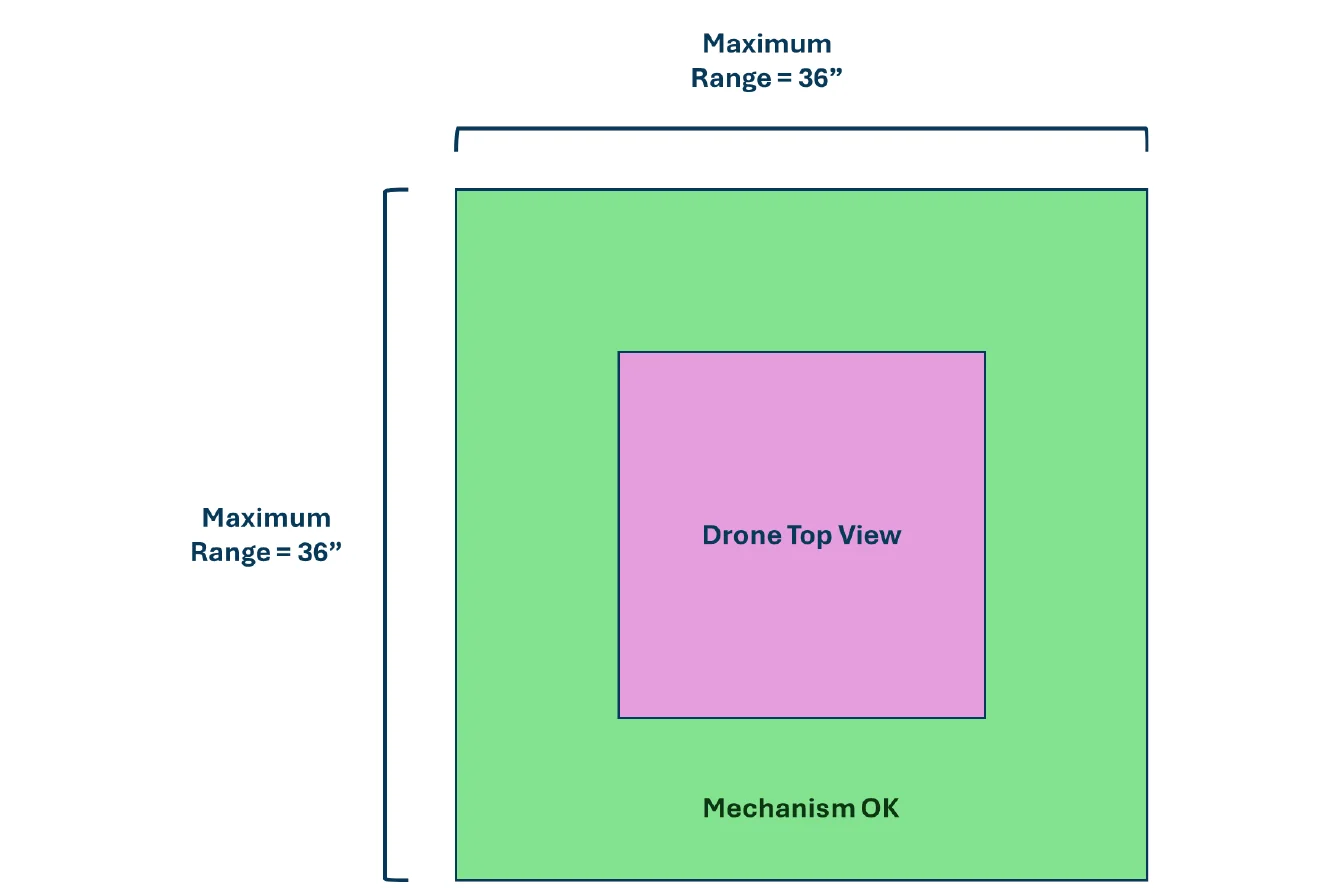
- The overall UAV dimensions must not exceed 36 inches by 36 inches by 36 inches when
placed on the ground with no propellers attached (the drone should be able to fit in a box that is a 36-inch cube).
- The UAV must have 4 motors with 1 propeller each. These propellers may not exceed 14
inches in diameter. The UAV must not have any lifting surfaces other than these propellers.
- The UAV must have a carabiner clip securely fastened within the tether zone (see Figure
4.2). This carabiner must be connected to the field tether carabiner before the drone may be powered on.
- The structure must be sturdy, as judged by the Technical Inspector. Components may not
be loose.
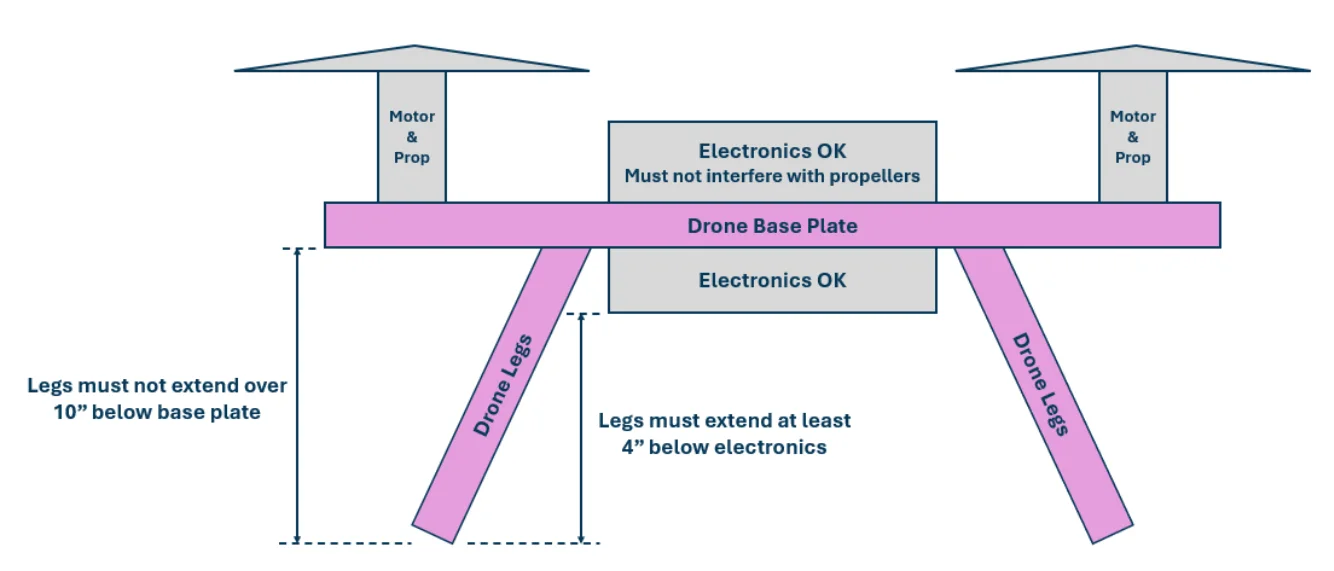
- The drone must stand on legs. The legs must extend at least 4 inches below the electronics
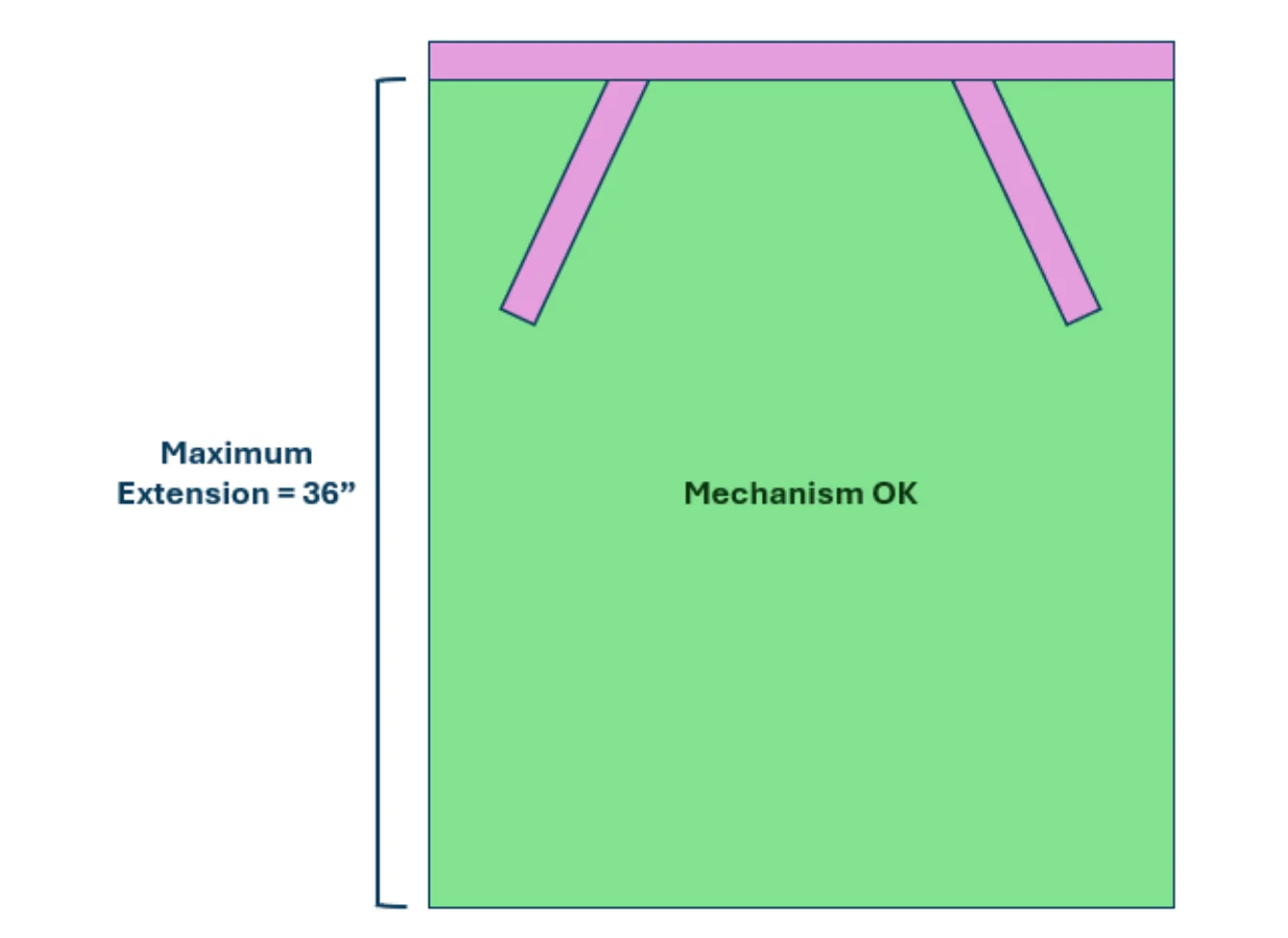
or drone structure closest to the ground. The legs must extend no greater than 10 inches below the drone base plate. See Figure 4.3.
4.1.2Mechanism Design#
Teams must create a unique mechanism that meets size and structural integrity requirements:
- Teams must design and build a unique mechanism to complete the flight tasks. Teams may
not use a Commercial Off The Shelf (COTS) mechanism, such as a pre-made claw.
- The mechanism may be controlled with multiple servos, but all servos are to be powered
by one single NiMH battery (see Section 4.1.4).
- The mechanism must begin within the mechanism allowable zone seen in Figure 4.2. The
mechanism may not extend above the drone base plate at any time.
- The mechanism may not detach from the drone at any time during flight.
- The mechanism must not extend beyond the mechanism allowable zone seen in Figure 4.3.
- Teams may use different mechanisms for different competition events, but all mechanisms
must pass technical inspection to be used (see Appendix B: Technical Inspection Rubric).
4.1.3Controls#
Teams must use the required electronics to control their drones:
- Teams must have a GPS sensor securely mounted onto the UAV.
- Teams must use one of the following flight controllers: o The Cube Orange+ o Pixhawk (any version)
- Sensors: o Teams may use the accelerometer, gyroscope, magnetometer, and barometer contained within the flight controller. o Teams may not purchase/use any additional sensors. o Teams may add an approved camera (see Section 4.1.6) to transmit live footage to their ground station.
- For teams choosing to use computer vision, a Raspberry Pi companion computer (any
version) may be used.
4.1.4Batteries#
Teams must use batteries that fit the following specifications (see Section 4.1.6 for recommendations):
- Main UAV Battery: o Teams must use a lithium polymer (LiPo) battery to power the flight controller. o The battery cannot have more than 6 cells. o Teams must use commercially available batteries. Homemade batteries are not allowed. o Teams must use proper battery usage/storage techniques – see Section 4.2. o Teams may not use any batteries displaying signs of damage, including dents, cracks, swelling, and smoking.
- Servo Battery: o Teams must use a nickel-metal hydride (NiMH) battery to power the mechanism servo/actuator.
- Safety: o Battery wires MUST be securely restrained away from propellers, servos, and the ground.
4.1.5Budget Requirements#
Teams may not exceed the budget requirements listed in Table 4.1 – this is a requirement for participating in the competition. Teams must provide a spreadsheet of all used items and associated costs (commonly known as a Bill of Materials, or BOM, in industry). Teams may list the actual purchase price for each item if it differs from the retail price.
| Item | Max. $ | Notes |
|---|---|---|
| Drone | $3,000 | Includes: |
| ||
| Mechanism | $300 | Includes: |
| ||
| Transmitter/Receiver | $200 | See recommended below. |
| Sensors | $0 | No additional sensors may be purchased. |
| Tether Supplies | - | Required carabiner |
| Camera | - | May use any for practice, but may only use required models at competition (see also Section 4.1.6).• Camera: Link• Camera Feed Monitor: Link |
| Camera Feed Monitor | - | |
| Total | $3,500 | Does not include required carabiner, camera, and camera feed monitor. |
4.1.6Supplies and Sources#
The following options are recommended as acceptable and compatible components for teams to use. Note that STEM-ED INC is not sponsored by nor endorses any of the recommended suppliers, and teams are not required to purchase through the provided links.
Required Components
- Carabiner: Any strong carabiner with a properly-functioning latch to link with tether carabiner.
- Camera Mount: o If using the ARC-provided RunCam camera, drones must have quick attachment method that does not damage the camera or its antenna. Teams may purchase a camera and monitor for practice (see links below), but teams may not bring them to the competition, as they may cause signal interference.
- Camera: RunCam Spotter V2 FPV Camera and 5.8GHz Transmitter (Link).
- Monitor: RunCam 5.8GHz .3” PV Display Screen (Link).
o If using the Arducam Camera for Raspberry Pi, drones do not need to have a quick attachment method, and teams should bring their own camera to the competition. These cameras will not be supplied by ARC.
Recommended Drone Kits
- Option 1: ARC-Recommended Drone Kit o See spreadsheet of components: stemed.org/recommendedsupplies
- Option 2: DEXI PX4 Development Kit (Link). Note that this drone kit will require the addition
of team-designed legs.
- Option 3: 2024-25 ARC Season Kit Drone o This kit is no longer available, but returning teams may use this kit if previously purchased. o See DRONE KIT LINK for recommended upgrade components.
- Option 4: Student-designed drone. o Teams may compete with any drone that meets all requirements within this rulebook. Teams are welcome to design a drone instead of using the above suggested kits.
Necessary Tools
- Soldering Iron
- Allen Wrenches
- Safety Glasses
- Zip Ties
- Computer o Research and access resources o Create budget spreadsheet o Create Technical Presentation slides o Complete virtual tasks
- Paper and Writing Utensils o Record notes during meetings. o Draw mechanism prototype ideas.
Banned Components
The following components may not be brought to the competition venue, as they would cause signal interference which may lead to drone malfunctions. This requirement is for both safety and sportsmanship and will be strictly enforced (see Section 5.2).
- Teams may not bring the RunCam Camera and Monitor set to the competition venue (see
“Required Components” above).
- Teams may not bring/use any device which may interfere with opponents’ telemetry signal.
4.2Safety and Legal Requirements#
STEM-ED INC will be releasing official guidelines for safety policies and adherence with FAA requirements. This document will include additional rules and will be considered an addendum to the 2025-26 ARC Regional Competition Rulebook.
Additionally, all pilots are expected to be able to perform their duties in a safe manner. If a pilot is unable to safely operate the drone for any reason, including but not limited to a medical emergency, he/she will be asked to land the drone and to allow a teammate to pilot during future rounds.
As previously mentioned, teams MUST follow the commands of the Field Manager, including where to stand and when to activate the Kill Switch.
For any safety and legal questions, please visit faa.gov/ and/or contact Support@stemed.org for assistance.
5Competition Rules#
5.1Logistics#
Upon arrival at the competition venue, teams must first report to the check-in table where volunteers will distribute items such as wristbands, schedules, and maps. Teams will then be directed to their pits, which will be their “home base” throughout the event. Teams will be able to keep all items at their pit table and charge batteries at a nearby battery charging station.
Once flying matches begin, teams must follow the routes as seen in Figure 5.1. Teams are expected to be at the queueing table on their respective side of the field during the match before their assigned time slot. Queueing volunteers will guide teams from the queueing table to the ground station table once their assigned time slot begins.
Teams who are not competing in the current match may not enter any field zones at any time. Students who are not the pilot or copilot, along with coaches, mentors, and parents/guardians, may not enter the red zone at any time. These rules are critical for safety, so all team members and spectators are expected to follow volunteer instructions and to exit areas immediately upon request.
5.2Conduct Requirements#
If teams believe they received an incorrect ruling during their flight round, they are welcome to discuss the issue with the Field Manager, who will be happy to correct any errors as needed. Ruling challenges may be made by student team members only, not parents/guardians, coaches, mentors, or spectators, and should remain cordial.
Teams are expected to adhere to safety rules at all times, including obeying field boundaries, keeping electronics powered off at all times off-field, completing a reinspection after a drone is damaged, and using the tether at all times on the field. Volunteers will provide guidance and reminders, but continued willful non-compliance will result in a discretionary penalty.
See Table 5.1 below for potential penalties, the distribution and value of which will be determined by the Field Manager and/or respective Regional Coordinator. These rules are in place to ensure the competition is safe and enjoyable for all. Teams attempting to follow rules and remain sportsmanlike will not need to worry about receiving these penalties.
| Penalty | Potential Value | |
|---|---|---|
| Safety Violations | Enter field without approval. | -50 |
| Attach battery without first attaching tether. | -50 | |
| Refusal to use Kill Switch when instructed by Field Manager. | DQ from all Rounds of Current Mission (No Warnings) | |
| Unintentional collision with opponent. | DQ from all Rounds of Current Mission (No Warnings) | |
| Intentional collision with opponent. | DQ from Competition (No Warnings) | |
| Sportsmanship Violations | Continued disobedience of explicit instructions, including to turn off a device or exit a zone. | -200 |
| Disrespectful treatment of an opponent or volunteer, including yelling and inappropriate language. | -300 | |
| Interference with opponent telemetry/radio communications. | -100 (Up to DQ if Egregious) | |
| Interference with opponent’s operations during Mission 2. | DQ Mission 2 (Up to DQ from Competition if Egregious) |
5.3Competition Day Supplies#
The following supplies are required for all teams participating:
- Drone!
- Safety glasses for pilots and copilots
- Battery charger
- TRUST Exam Certificates for all pilots
- If using camera: o Camera mount
The additional supplies listed below are highly recommended. Note that competitions are conducted outdoors, and thus teams should prepare for the weather and a long day of standing.
- Sunscreen
- Water
- Snacks
- Spare batteries
- Spare propellers
- Common tools and adhesives
- Weather-appropriate attire (hats, shorts, jackets, sunglasses, etc.)
- Comfortable shoes
- Hair ties (as needed)
- First aid kits
- Medications (as needed)
6Awards#
Prizes will be awarded to the top three teams overall, based on total score as aggregated from each of the three parts of the competition. Teams must successfully fly at the competition (take off and sustain flight for over 30 seconds) in order to be eligible for prize money.
| Achievement | Award |
|---|---|
| 1 st Place, Overall | $2,000 |
| 2 nd Place, Overall | $1,000 |
| 3 rd Place, Overall | $750 |
Appendix A: Scoring Sheets
Scoring Sheet – Mission 1
Scoring Sheet – Mission 2
Scoring Sheet – Virtual Missions
Scoring Sheet – resentation Content 1
Scoring Sheet – resentation Content 2
Scoring Sheet – resentation Style
Scoring Sheet – Ethics Vignette
Appendix B: Technical Inspection Rubric
Technical Inspection Rubric, Side A
Technical Inspection Rubric, Side B
Appendix C: Example Budget
See the figures below for an example budget, which was created in Microsoft Excel. The third figure includes instructions for basic Excel commands to calculate sums and differences of values.
Example Budget - Competition Budget
Example Budget - Extra Items
Example Budget – Calculate Remaining Funds
Appendix D: Resources
2025-26 Season Documents
- 2025-26 Field Kit Assembly Guide: stemed.org/arc
- FAA guide: stemed.org/arc
- Safety guide: stemed.org/arc
- Recommended drone components: stemed.org/recommendedsupplies
STEM-ED INC Technical Resources
- ARC Video Series: stemed.org/resources
- ARC Tutorials: stemed.org/resources
- Office Hours: stemed.org/events
- Coach Training: stemed.org/events
- STEM-ED INC Forum: Coming Soon!
Additional Resources*
- Mission Planner Instructions: ardupilot.org/planner/
- Holybro Product Documentation: docs.holybro.com/
*STEM-ED INC is not affiliated with the creators of these resources and cannot guarantee the quality or accuracy of these websites.
Appendix E: Recommended Supplies
Drone
See stemed.org/recommendedsupplies for an itemized list of recommended components.
Teams may also choose to create a mechanism to manipulate objects on the field. Materials, such as wood, 3D-printed plastic, carbon fiber, and aluminum, should be selected by function and cost.
Tools
| Tool | Example | Notes |
|---|---|---|
| Soldering Iron | Link | Use with caution |
| Electrical Tape | Link | Use to cover any wire connections. Do not leave any bare wires. |
| Zip Ties | Link | Use to organize wires. Do not leave wires loose enough to tangle in propellers. |
| Allen Wrenches | Link | Use to assemble drone kit. |
| Safety Glasses | Regular | Wear when:• Using soldering iron• Cutting materials• Piloting/copiloting drone |
| Over Glasses | ||
| Computer |
| |
| Paper/ Writing Utensils |
|
Appendix F: Mission Diagrams
See the figures below for diagrams of Mission components and tasks. Figures are approximate and not to scale.
Mission 1 Diagrams
round Station Setup
Mission 2 Diagrams
Landing ad Scoring – Location
round Station Setup
Technical Inspection Diagrams
Example Technical Inspection Setup
Presentation Diagrams
Example Technical/Ethical resentation Room Setup
2025-26 National Championship Rulebook Rev A
Page 66
Revision History
| Revision | Date | Notes |
|---|---|---|
| A | October 4, 2025 | Initial Release |
| B | January 4, 2026 |
2025-26 National Championship Rulebook Rev A
Page 67